

For years, my meditation seat was a folded blanket. I stacked it, smoothed it, and still found myself shifting my weight by minute five, my hips complaining and my lower back slowly curling into a question mark. My name is Naomi Whitfield. I have kept a daily sitting practice for about fifteen years, but for too many of those years, the sitting itself was the hardest part. About four years ago, I swapped that blanket for the Retrospec Sedona Zafu Meditation Cushion, and it has held a corner of my practice space ever since.
I mention the brand up front because I know what it is like to read a review that hides the product until paragraph twelve. This is a review of a specific cushion, by a specific person, after years of use, not a roundup of every cushion on the internet. If you are looking for a firm, adjustable seat that helps you sit longer without fidgeting, this one is worth your attention. If you want something soft and plush, keep reading, because this cushion is not that.
The Quick Verdict
A firm, adjustable buckwheat zafu that helped me sit through a full twenty-minute sit without rearranging myself. Four years in, it still holds its shape and its place in my morning routine.
Amazon Check Today's Price →Sit longer without the fidgeting
The Retrospec Sedona Zafu uses buckwheat hulls and a firm crescent shape to lift your hips and ease the load on your lower back. It is the cushion I reach for most mornings, and it has held up through four years of daily use.
Amazon Check Today's Price on Amazon →How I've Used It
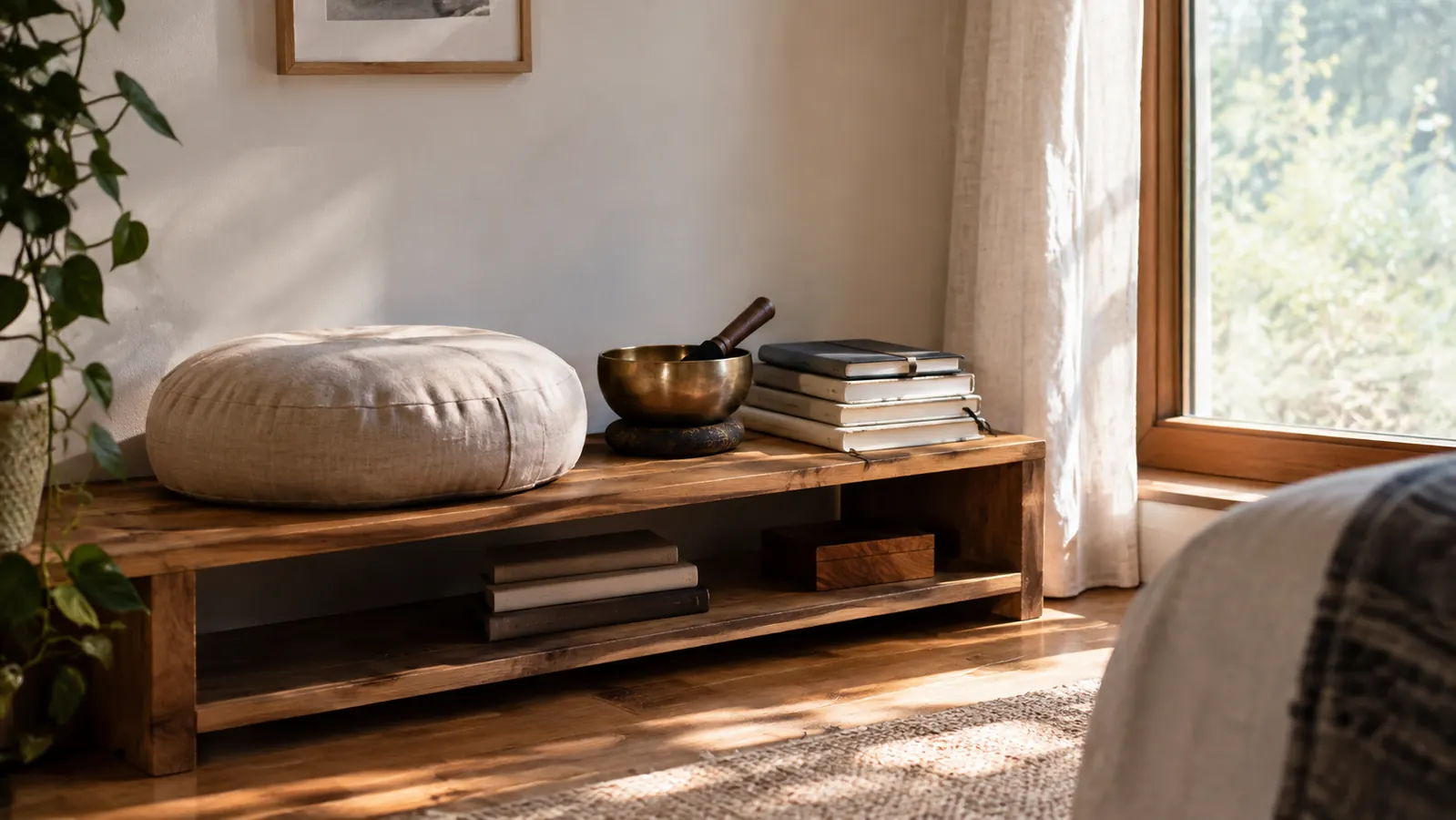
My practice is not dramatic. I sit for about twenty minutes most mornings before breakfast, in a corner of our spare bedroom by an east-facing window. There is a low wooden shelf beside me with a singing bowl, a diffuser, and a small stack of journals. Before the Sedona arrived, I sat on that folded blanket, and I spent a good part of every sit negotiating with my body: shifting a hip, straightening my spine, uncrossing an ankle.
I bought the Sedona about four years ago, during a stretch when my lower back was stiff and my hips felt tight no matter how I sat. I had read that a zafu cushion lifts your hips above your knees, which tilts the pelvis forward and takes pressure off the lower back. I was skeptical. It seemed too simple to matter. But within the first week, I noticed I was not shifting as often. By the end of the first month, a twenty-minute sit felt like a reasonable length of time instead of a negotiation.
Today the cushion lives in that same corner. I use it most mornings, and I take it with me on Tuesday evenings when I lead a small meditation circle at the public library. It is light enough to carry under one arm, and I like that my seat is the same from home to the library. There is something settling about sitting on the same familiar cushion in a different room.
I wash the cover a few times a year. It comes clean easily, and because the buckwheat hulls stay in the inner compartment, washing does not disturb the fill. I let it air dry, and it looks the same as it did the day I bought it.
What the Sedona Zafu Actually Is
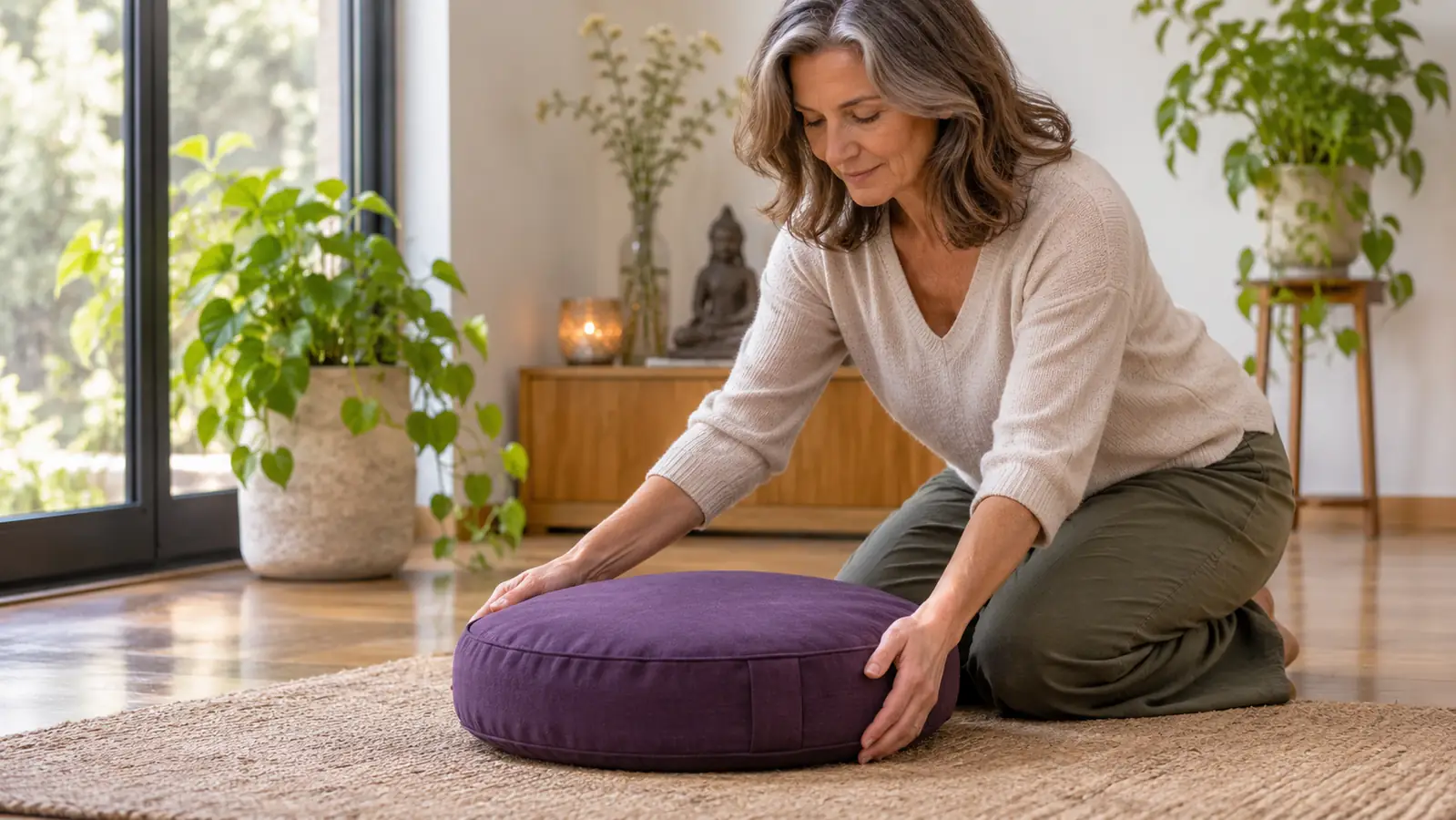
The Sedona is a crescent-shaped zafu, which means it is curved rather than round. The curve is not cosmetic. When I sit on the higher part of the crescent, my hips are lifted and my knees can drop lower than my hips, which is the position my stiff lower back appreciates most. The cushion measures 17 inches long, 10.5 inches wide, and 5.5 inches tall, and it weighs 16 ounces, so it is substantial enough to feel supportive without dominating the room.
The fill is buckwheat hulls. This is the detail that matters most to me. Buckwheat hulls are firm and slightly springy, and they shift a little as you settle, molding to the shape of your body. Unlike foam, they do not flatten out over a year of use. The hulls are held in an inner compartment with a zipper, so you can unzip it and add or remove hulls to change the firmness. I removed a small handful early on, and I have not needed to adjust it since.
The outer cover is 100 percent cotton, and it is machine washable, which I appreciate more than I expected to. I wash it a few times a year, and it has held up well. The manufacturer backs it with a one year limited warranty, which is reassuring for a cushion you sit on daily. I have not needed the warranty, but I like knowing it is there.
The listing also notes that the cushion can double as physical therapy equipment or exercise support. I have not used it that way myself, but I can see how the firm fill and stable base would work for floor exercises. I mostly use it for sitting, but it is good to know it is not a one-purpose object.
How It Has Held Up Over Four Years
The honest answer is: remarkably well. The buckwheat hulls have not gone flat. The cotton cover has softened with washing but has not torn or pilled in any noticeable way. The zipper on the inner compartment still works smoothly, which matters because I have opened it a handful of times over the years to check the fill.
The firmness has stayed consistent. That is the main thing I worried about when I bought it. I had owned foam cushions before that felt supportive for a few months and then turned into pancakes. The buckwheat hulls do not have that problem. They shift when I sit down, then hold. Four years in, the cushion feels essentially the same as it did in the first month.
There is one thing to know: buckwheat hulls make a soft rustling sound when you shift your weight. I do not notice it during my sit anymore, but someone who wants total silence might. I also keep the cushion out of direct sunlight when the window is open, mostly out of habit, though the cover has shown no signs of fading.
The only maintenance I have done is washing the cover and, once, adding back a few hulls after I removed too many. The inner compartment closes securely, and I have never had hulls escape onto the floor. That was a concern of mine before I bought it, and it has not been an issue.
The Small Shifts I Noticed
I am careful not to promise that a cushion will change your life, because it will not. What it did for me was smaller and more practical. I stopped dreading the sit. When the discomfort of sitting was the loudest thing in the room, I found reasons to skip days. Once my hips were supported and my back could relax, the resistance faded. I sit more often now, not because I am more disciplined, but because the sitting itself is more comfortable.
I also noticed that I fidget less. This sounds minor, but it changes the quality of a sit. When I was constantly adjusting, my mind was constantly returning to my body in a distracted way. Now I settle once, and my mind has a better chance of settling too. I do not claim to have achieved anything special. I just sit, and when my mind wanders, I come back. That is the whole practice, and the cushion makes it easier to stay.
There is one more shift worth mentioning. Because I take the cushion to my Tuesday circle, it has become a kind of cue. When I pick it up, my body remembers what is coming. I have read that habit researchers call this a cue, and I think that is exactly right. The cushion does not do the work, but it quietly reminds me that it is time to sit.
At the Tuesday circle, I have learned that the cushion works for some people and not others, and that is fine. One woman in my circle prefers a folded blanket under her knees. Another brings her own round cushion. On Tuesday evenings I carry the Sedona to the library for the circle and bring it home again afterward, and those trips have not left any visible wear.
I used to spend the first ten minutes of every sit shifting my weight. Now I sit down, settle once, and stay there for the whole twenty minutes.
The Tradeoffs I Noticed
First, this cushion is firm. That is the point, but it is worth saying plainly. If you are used to soft seating, the first few sits will feel intense. Your hips will be lifted higher than you are used to, and your knees will be lower. For me, that position was exactly what my stiff lower back needed. For someone with very sensitive knees, it might be too much at first, and you may want a mat or a folded blanket under your knees.
Second, the crescent shape takes a little getting used to. It is not a round cushion, and you cannot sit in the middle of it the way you would a round zafu. You sit toward the higher edge of the curve. I figured this out quickly, but I have had a few people at my Tuesday circle try it and look puzzled for a moment. It clicks once you are sitting on it.
Third, the fill adjustment is real but not instant. You can unzip the inner compartment and add or remove hulls, but you cannot fine-tune it the way you might adjust a foam cushion by squeezing it. You have to take out a handful, sit, and see how it feels. I did this once, found my setting, and have not touched it since.
Alternatives I Considered
Before the Retrospec Sedona, I sat on a folded blanket for years. The blanket worked well enough, but it never gave me the hip lift I needed. I also tried kneeling on a low bench at a friend's house, and I liked it, which is why I later bought a meditation bench for the stiff mornings when my lower back needs a different angle. I still use both. On most days, I sit on the Sedona. On the days my back is especially stiff, I reach for the bench. They share the same corner, and I do not think of them as competitors.
I have also sat on round zafus at a meditation center I visited years ago. Round zafus are lovely, but I found that my hips wanted the curve of the crescent. This is a personal preference, not a universal truth. If you already sit comfortably on a round cushion, there is no reason to switch. If you have tried a round zafu and found yourself sliding forward, the crescent shape is worth considering.
The Sedona is the cushion I would choose again. It is not trying to be the most beautiful object in the room. It is a straightforward, well-made tool that does the one job I need it to do: hold my hips in a position where my back can relax.
What I Liked
- Buckwheat hull fill holds its shape and firmness after four years of daily use
- Adjustable fill: unzip the inner compartment to add or remove hulls
- Machine-washable cotton cover comes clean easily
- Crescent shape lifts the hips and eases lower back strain
- Lightweight at 16 ounces, easy to carry to a meditation group
- One year limited warranty
Where It Falls Short
- Firm feel is not for everyone, especially at first
- Buckwheat hulls rustle softly when you shift
- Crescent shape takes a sit or two to get used to
Who This Is For
If you sit on the floor and your hips or lower back complain, this cushion is worth trying. It is for people who want to sit longer without fidgeting, who are willing to adjust the fill once and then leave it alone, and who prefer a firm, supportive seat to a soft one. It is also for people who sit in a group, because it is light enough to carry and familiar enough to make a library meeting room feel a little more like home.
If you are newer to meditation and not sure whether you will stick with it, a zafu is a reasonable first purchase because it makes the physical part of sitting easier, and that is the part that stops many beginners. It is also a good choice if you already know you want to sit on the floor but your current setup is a stack of pillows that slides around.
Who Should Skip It
If you want a plush, pillow-like cushion, this is not it. If you prefer to sit in a chair or on a bench and have no interest in the floor, you do not need a zafu at all. And if you are looking for something that will fix your posture without any effort on your part, no cushion can do that. The Sedona helps by holding your hips in a better position, but you still have to sit down and do the practice. I would also say this: if you are dealing with a specific injury or chronic pain, please talk to a professional. A cushion is a comfort, not a treatment.
Four years of mornings, still my first choice
The Retrospec Sedona Zafu Meditation Cushion is the seat I reach for most days. If you are looking for a firm, adjustable cushion that holds up to daily use, it is worth a look.
Amazon Check Today's Price on Amazon →