
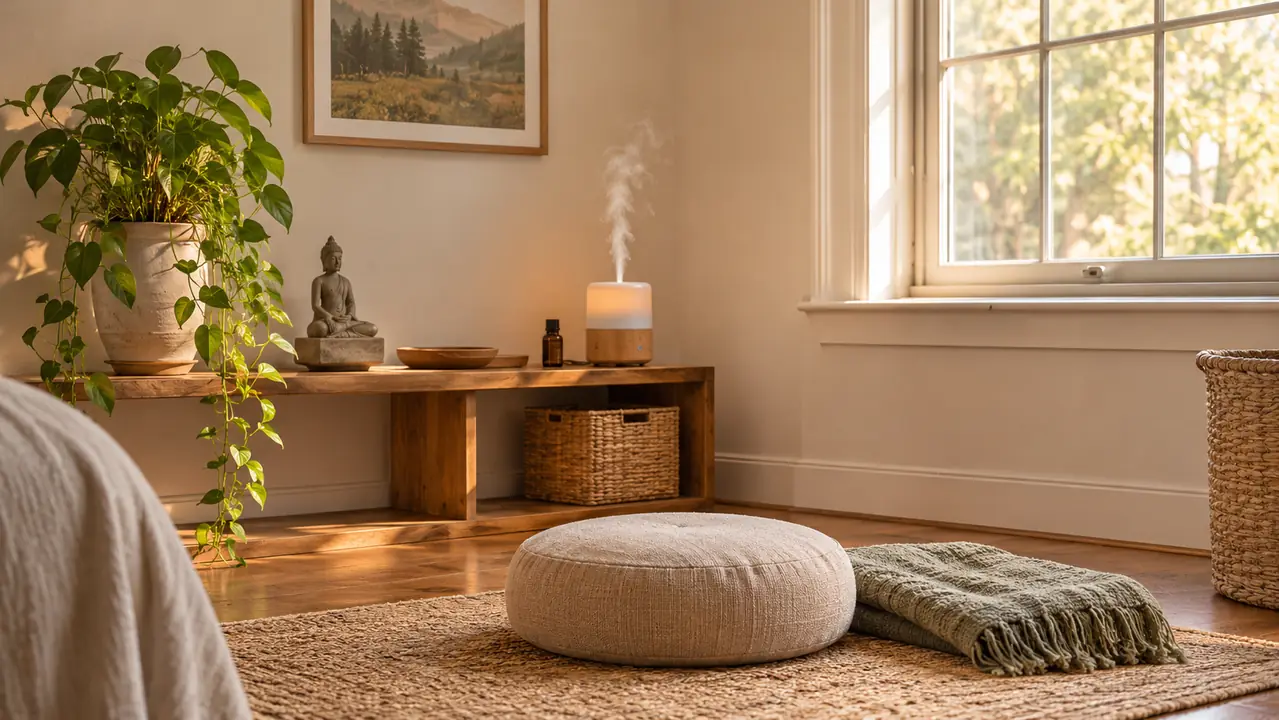
The hardest part of a meditation practice is rarely the sitting. It is the getting to the cushion. I have kept a daily sit for about fifteen years, and I can tell you the exact moment my practice got easier: when I stopped expecting myself to walk into a cold, cluttered room and instantly feel calm. I built a corner instead. A corner of my spare bedroom by an east-facing window, with a low wooden shelf, a zafu I have owned for about four years, and a small InnoGear diffuser running a few drops of lavender. That is the whole setup. It did more for my consistency than any app or retreat. I did not start with the diffuser. I started with a blanket and a timer, and I added the rest slowly, one piece at a time, as each one proved itself.
This guide is the five steps I would walk through with anyone who asks, including the people in the Tuesday evening circle I lead at the library. None of it requires a dedicated room or a big budget. You need a corner, a comfortable seat, a few small objects that signal practice time, and a way to mark the beginning and end of a sit. The diffuser is the piece that ties the sensory part together, because scent is the fastest cue I know for shifting from the day's noise into a quieter gear. The order matters. Corner first, seat second, scent third, frame fourth, and restraint last.
Start With a Diffuser That Stays Out of the Way
The InnoGear Essential Oil Diffuser is compact, quiet, and runs for up to 8 hours on a single fill, which covers a morning sit and an evening journaling session. It has sat on my low shelf for about two years.
Amazon Check Today's Price on Amazon →Step 1: Choose the Corner, Not the Room
A practice space does not need to be a whole room. Mine is a corner of the spare bedroom, about the size of a large armchair, with an east-facing window on one side and a low wooden shelf on the other. What matters is that the spot is quiet, that I can sit there without being in the path of household traffic, and that it looks the same every day. Familiarity is the point. When the corner looks the same, the mind starts to settle the moment I walk into it. I chose the east-facing window on purpose. Morning light is gentle, and watching it change through a sit is a quiet anchor when the mind wanders.
If you live in a small house like mine, a corner of a bedroom or living room works fine. A hallway nook can work too. The only hard requirement is that you can leave the setup in place between sits. If you have to pack everything away each time, the friction returns and you will sit less. I learned this the slow way: for years I sat on a folded blanket that I stored under the bed, and I skipped far more days than I would like to admit. A corner that has to be rebuilt every day is a corner that gets skipped on busy mornings, and busy mornings are exactly when most people need the practice most.
Once you pick the spot, sit in it for a few minutes before you buy anything. Notice the light, the sounds from the rest of the house, whether your back is happy against the wall. The corner should feel like a small refuge, not a stage. If it does not, adjust the angle of the seat or the position of the shelf before you add anything else.
Step 2: Make the Seat Genuinely Comfortable
I have a stiff lower back and tight hips, so the seat is the first thing I sorted out. For years I sat on a folded blanket and spent most of my sit shifting my weight. Then I bought a zafu, a round cotton cushion, about four years ago, and it changed how long I could sit without fidgeting. On mornings when my back is especially stiff, I use a low meditation bench instead. Both live in the same corner and I choose based on the day. The bench was a winter purchase, after a stretch when my lower back made the zafu feel too low. It took me a few weeks to admit I needed it, and I am glad I did.
You do not need a specific cushion to start. A folded blanket, a firm throw pillow, or a stack of books can all work in the first week. The test is simple: can you sit for ten minutes without your legs falling asleep or your back screaming? If the answer is no, raise the seat height or add support under your knees. The goal is a seat you forget about, because the whole point is to think about your breath instead of your hips. If you have hip or knee trouble, sitting on the edge of a firm chair is a perfectly good seat. The tradition matters less than the comfort, and the comfort matters because it lets you stay.
Sit upright but not rigid. I rest my hands on my thighs, close my eyes, and let my shoulders drop. If you are new to sitting, start with five minutes and add a minute each week. The corner and the seat are doing their job when you stop noticing them.
Step 3: Set the Scent Cue
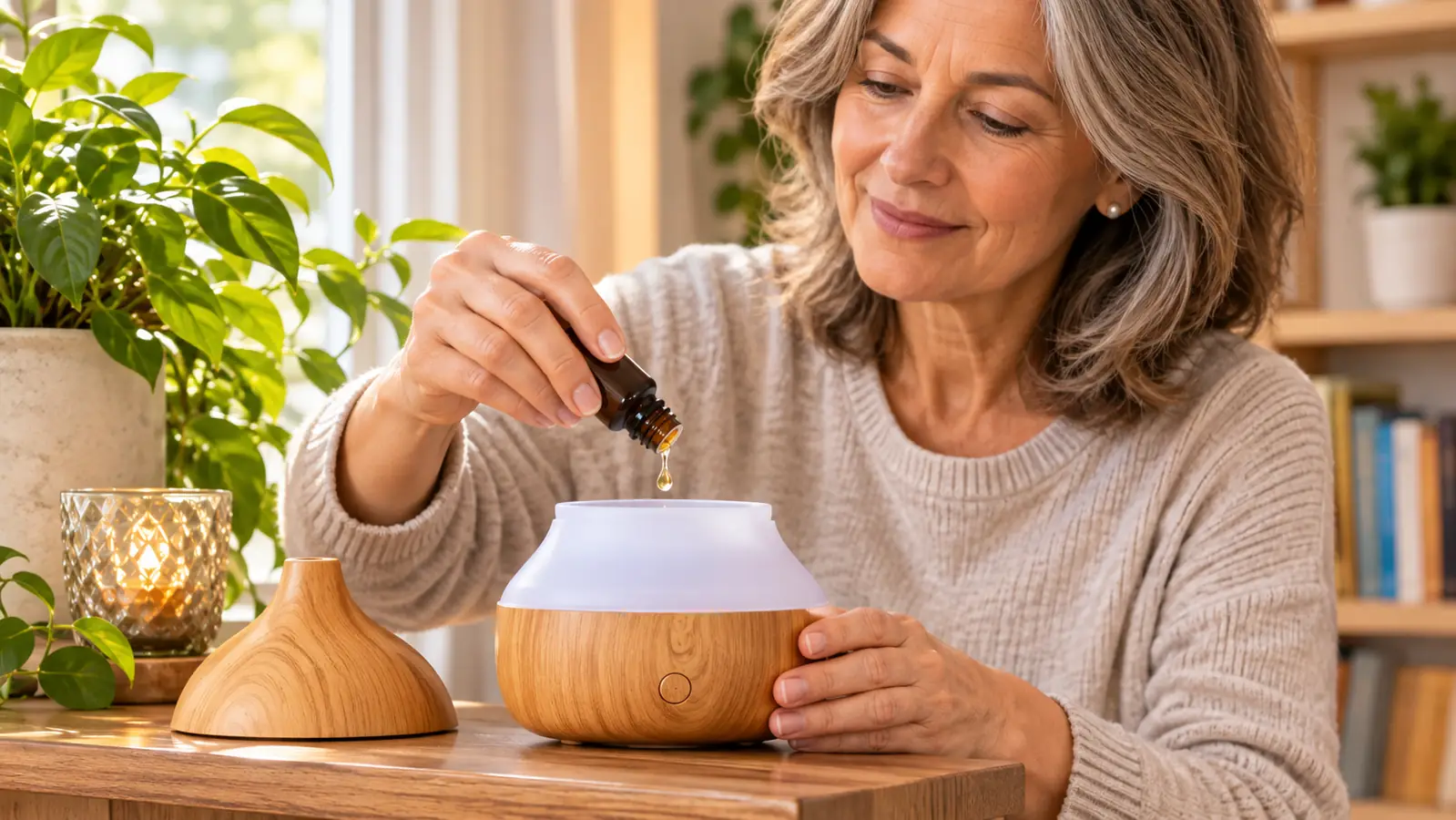
This is where the InnoGear diffuser earns its place. I keep mine on the low wooden shelf, fill the 100 ml tank with water, and add a few drops of lavender or cedarwood before my morning sit. The cool mist is gentle, the fan is ultra-quiet, and within a minute or two the corner smells like practice. I treat the scent as a cue for the habit, never as a treatment for anything. It simply tells my nervous system, the way a familiar song does, that we are shifting gears. I fill the tank in the evening sometimes, so the corner is ready before I am.
The diffuser has two mist settings, so I can choose a steady stream for a longer sit or a lighter interval when I only have ten minutes. It runs for up to 8 hours on a full tank, which means I fill it once in the morning and it is still going when I sit down to journal in the evening. The LED light offers seven colors, and I usually set it to a soft one and leave it there. During the Tuesday circle I sometimes switch to a different color to change the feel of the room. The 100 ml tank is small enough to fill from a glass of water and large enough to last through the whole morning.
If you are sensitive to scent, start with a single drop. Lavender and cedarwood are the two I reach for, but any essential oil you genuinely like will work. The important thing is to use the same scent most days, because the repetition is what builds the cue. When the same smell shows up every morning, your mind starts to settle before you even sit down. One woman in my circle uses a citrus oil in the morning and a woodsy one at night, and she says the switch helps her tell the two sits apart.

Step 4: Mark the Beginning and End
A practice needs a frame, a clear start and a clear finish. I strike a singing bowl once to open the sit and once to close it. I have owned my Silent Mind bowl for about three years, and it does two jobs: it is a timer and a signal. The sound tells me the sit has begun, and it tells the rest of the house to leave me alone for twenty minutes. When the bowl rings again, the sit is over and I can get on with the day. The bowl does not need to be expensive. Mine was a gift, but a thrift store bowl or a kitchen bell does the same job.
If you do not have a bowl, a small bell works, or the chime on your phone. The object matters less than the consistency. I set a gentle timer on my phone as a backup, because I would rather check the time than watch the clock. The diffuser helps here too, because the scent fades as the sit goes on, and noticing that fade is a subtle way to stay present without staring at a timer. I keep the timer on the floor beside me, face down, so I am not tempted to glance at it.
The frame also includes what happens after. I sit first, then I fill in the morning lines of my journal. I have been using the same five-minute journal format for about a year, my third copy, and the routine works because the order never changes: bowl, sit, journal. The corner holds all of it, which is why it earns its place. On evenings when I am tired, the journal lines are short, and that is fine. The point is to show up, not to produce.
Step 5: Keep the Corner Simple and Consistent
The biggest mistake I see in new practitioners is adding too much. A shelf full of crystals, three kinds of incense, a stack of unread books on meditation, and suddenly the corner looks like a store display and feels like a to-do list. My corner has exactly this: a zafu, a bench for stiff mornings, a singing bowl, a journal, and the InnoGear diffuser on the low shelf. That is it. Every object earns its place by being used at least once a week. When I am tempted to add something new, I ask myself one question: will I actually use it this week? If the answer is no, it does not come into the corner.
Consistency beats intensity. A five-minute sit every day does more for your practice than a forty-minute sit once a month. The same goes for the corner: it is better to have a small, plain corner that you actually use than a beautiful one you walk past. When I travel, I do not try to recreate the corner. I sit on the hotel bed, skip the scent, and keep the practice. The corner is a support, not a requirement. The same rule applies to the practice itself. A short sit on a hard day is still a sit, and it keeps the thread from breaking.
Once a month I dust the shelf, wipe down the diffuser, and wash the cushion cover. That small reset keeps the corner feeling cared for, and it gives me a reason to stand in the space and remember why I built it. A corner that is clean and ready makes the next sit easier, and easier is what keeps the practice alive. I also air the corner out on warm days, opening the window wide so the room does not start to smell like yesterday's oil.
What Else Helps
Three things support the corner without becoming part of it. The first is a regular time. I sit most mornings before breakfast, and the predictability is half the habit. The second is a gentle timer, because watching the clock is the fastest way to stop being present. The third is a way to capture what comes up, which for me is the journal I fill after the sit. None of these are required. They are simply the supports I reached for when the corner alone was not enough, and they are the ones I recommend to the people in my Tuesday circle when they ask what else they should add. If you sit with pain that does not ease with a better seat, please talk to a doctor or a physical therapist. I am not one, and neither is any article. A comfortable body is the foundation of a sustainable practice, and there is no shame in getting help to find it.
The corner should feel like a small refuge, not a stage. When it looks the same every day, the mind starts to settle the moment you walk into it.
Build the Corner Around a Diffuser That Stays Quiet
The InnoGear Essential Oil Diffuser has run on my shelf for about two years. It is compact, quiet enough to forget, and the 8-hour runtime covers a morning sit and an evening journaling session on one fill.
Amazon Check Today's Price on Amazon →