

For years I sat on a folded blanket. It worked the way a lot of things work: well enough that I did not think about it, and badly enough that I spent the first ten minutes of every sit shifting my weight, uncrossing my legs, and trying to find a position that did not make my lower back complain. I have a stiff lower back and tight hips, and at fifty-eight that is not getting better on its own. When a friend in my meditation circle mentioned the Retrospec Sedona Zafu Meditation Cushion, I almost did not try it. I had seen enough pretty cushions on enough shelves to be skeptical. But I have owned mine for about four years now, and it is the reason my morning sit actually happens instead of being a thing I keep meaning to do.
This guide is not about enlightenment or a changed life. It is about the practical part of practice: how to sit down, get comfortable, and stay there long enough for the quiet to arrive. If you are new to meditation, or if you have tried before and given up because your knees or your back made it impossible, the cushion is a small fix that makes a real difference. Let me show you how I use mine.
Sit longer without the fidgeting
The Retrospec Sedona Zafu Meditation Cushion is the cushion I reach for most mornings. It is firm, adjustable, and washable, and it has held up through four years of daily use.
Amazon Check Today's Price on Amazon →Step 1: Set up your corner before you need it
The biggest thing I learned in fifteen years of practice is that I do not meditate when my space is a project. If I have to move a pile of laundry, clear a chair, or hunt for a cushion, I will talk myself out of sitting. So the first step is to make the corner ready the night before, or at least make it ready once and then keep it that way.
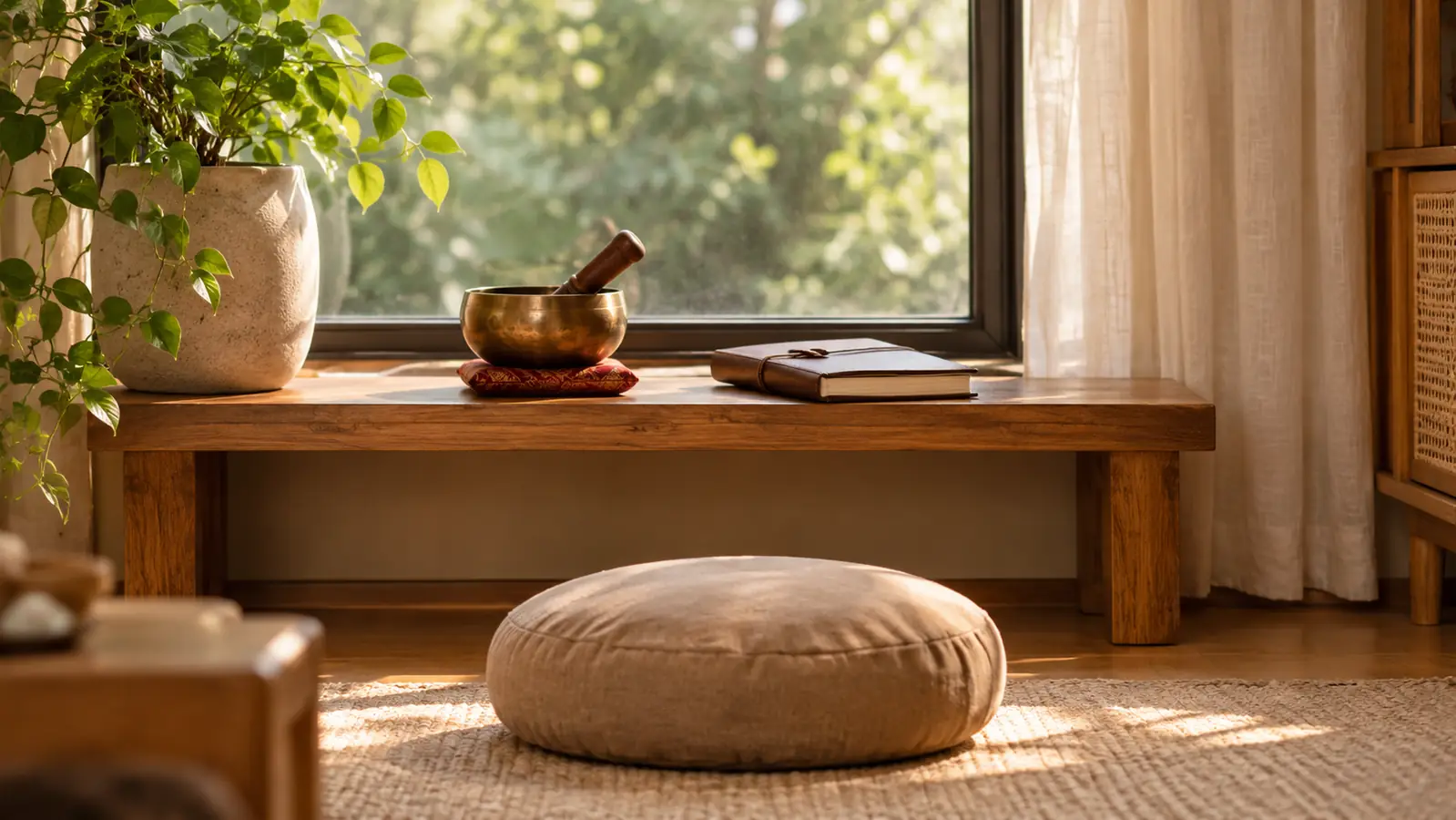
My practice space is a corner of the spare bedroom by an east-facing window. There is a low wooden shelf with a few things on it: a singing bowl I strike once to open and once to close my sit, and the journal I write in during the evening. The Retrospec Sedona Zafu sits on the floor in front of the shelf, ready. Nothing else. I do not have to set anything up in the morning. I just walk in, sit down, and begin.
If you do not have a spare room, a corner of the bedroom or even a spot in the living room works. The important part is that the cushion lives in the place where you sit, not in a closet. When the zafu is already on the floor, the decision to sit is half made. I learned that the hard way one Tuesday last spring. I had cleaned the spare bedroom the day before and set the cushion on the shelf instead of the floor. The next morning I stood in the doorway, looked at the corner, and nearly walked away because pulling the cushion down felt like too much effort. Now the cushion lives on the floor, always. The shelf is for the bowl and the journal. The floor is for sitting.
Step 2: Adjust the fill to your body, not the picture on the box
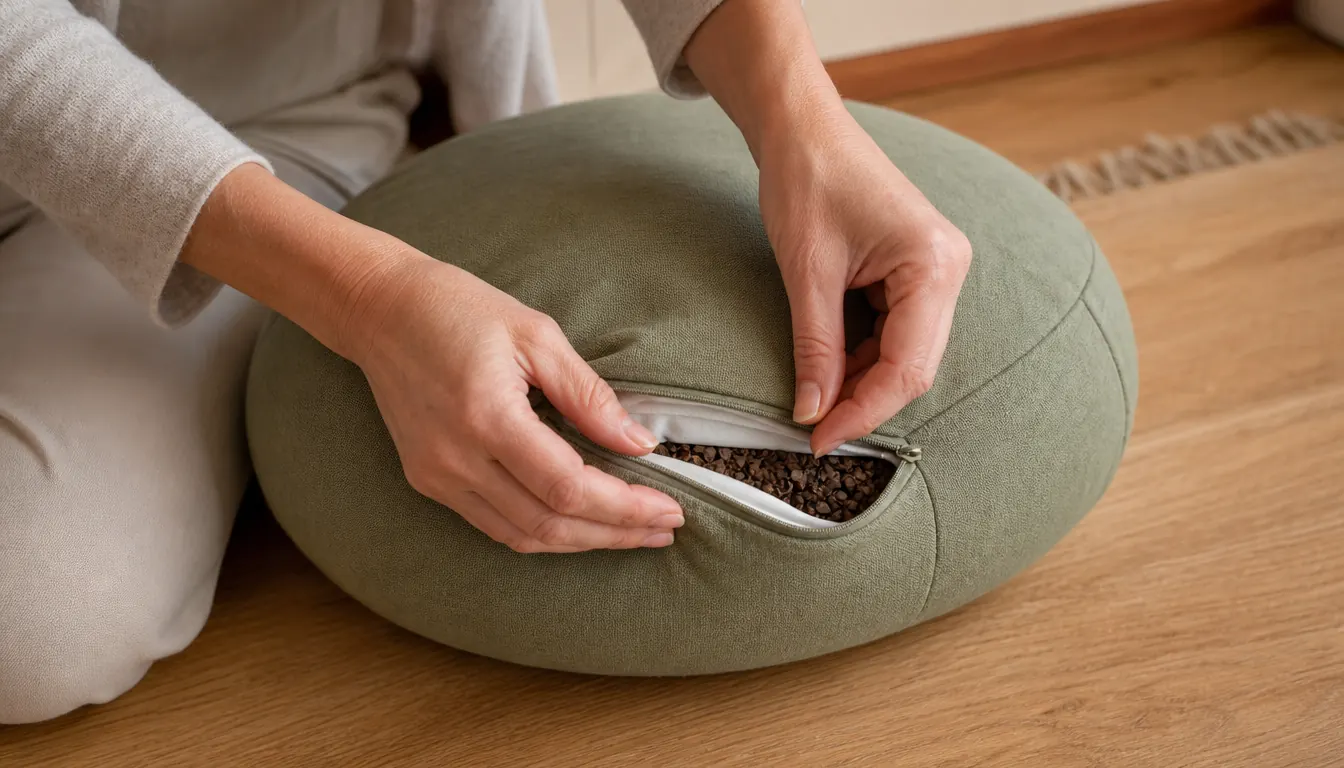
The Retrospec Sedona Zafu comes filled with sustainable buckwheat hulls. That is what gives it that firm, supportive feel that a soft cushion cannot match. But here is the thing nobody tells you: the firmness that works for one person may not work for you. The good news is that you do not have to accept the default. You can unzip the inner compartment and add or remove buckwheat hulls to create the ideal firmness for your body. At the full fill, mine measures about 17 inches long, 10.5 inches wide, and 5.5 inches tall, and it is firm. The first time I sat on it, that height tipped my hips forward a little too much, so I unzipped the inner compartment, scooped out roughly a cup of hulls with my hand, and zipped it closed. The whole cushion weighs only about 16 ounces, so even with the fill adjusted it is easy to lift and move, though mine has not left the corner in years.
My husband, who sits with me sometimes on Sunday mornings, added a little back in because he wanted more height. It took him about ten minutes to find his level, and now we both use the same cushion without thinking about it. That is the whole point: the cushion is adjustable, so it can fit both of us. There is no wrong fill level, only the one that lets you stop thinking about your hips and start thinking about your breath.
A note on the cover: it is 100 percent cotton, and it is washable. I have washed mine a few times over the years, and it has held up well. The inner compartment stays closed while the cover is in the wash, so the buckwheat hulls do not go anywhere. The whole cushion carries a one-year limited warranty, which I mention because most cushions I have owned came with no warranty at all.
Step 3: Find the position that lets your spine stack
The whole job of a zafu is to elevate your hips so your pelvis can tilt forward slightly, which lets your spine stack naturally instead of rounding. When I sat on a folded blanket, my hips were lower than my knees, my lower back rounded, and within five minutes I was slumping. On the Retrospec Sedona, my hips sit a few inches higher, and my spine finds its own alignment without me having to force it. Last fall I spent a week traveling and left the cushion at home. I folded a blanket the way I used to, and by the fifth morning my lower back was tight enough that I cut my sit short. That week reminded me what the cushion actually does. It is not magic. It is geometry.
The cushion is shaped like a crescent, which is a shape I have come to appreciate. The curve gives your legs a little room to settle, and the firm buckwheat fill does not flatten out under you the way a soft cushion does. A round cushion pushes my knees forward; the crescent gives them somewhere to go. I sit with my legs crossed in a simple position, my hands resting on my knees, and my chin slightly tucked. It is not a perfect lotus or anything dramatic. It is just a position I can hold for twenty minutes without my back screaming at me.
If you are new to sitting, do not try to force a full lotus or even a half lotus. Sit however your body allows: cross-legged, on your shins, or even with your legs straight if that is what feels best. The cushion is doing the important work of lifting your hips. The rest is just practice.
Step 4: Keep the sit short and consistent at first
I have been meditating seriously for about fifteen years, and I still do not sit for an hour. I sit for about twenty minutes most mornings before breakfast. When I started, I sat for five minutes. Sometimes I sat for three. The length did not matter as much as the fact that I kept showing up. I remember one winter when I was caring for my late mother, the five-minute sit was the only quiet I got all day. I would sit on the folded blanket I had then and count the minutes until the timer rang. It was not a beautiful practice. It was a necessary one, and it is why I tell people to start embarrassingly small.
A cushion cannot make you disciplined. But it can remove the physical reasons you have to quit. When your hips are comfortable and your spine is aligned, the only thing left to wrestle with is your mind, and that is exactly the practice. I tell people in my Tuesday evening circle at the library to start with five minutes and add one minute a week. By the end of two months, you are sitting for thirteen minutes without having to white-knuckle it. One woman in the circle started with three minutes because even five felt like too much. She is up to fifteen now, and she sits on the same model of cushion after trying mine one evening. It took her three tries to find the right fill level, and now she brings it to the library in a cloth bag every Tuesday.
Use whatever anchor works for you: the breath, a word, the sound of a bell. I strike my singing bowl once to open and once to close each sit. It is not about the sound healing anything. It is a signal to my nervous system that we are starting, and later, that we are done.
Step 5: Make it a habit by making it pleasant
The habit sticks when the experience is something you want to return to. That is why I keep my practice corner pleasant. On the low shelf, beside the singing bowl and the journal, there is a small diffuser that I run during my morning sit and evening journaling with a few drops of lavender or cedarwood. Scent is a cue for me, a way of telling my brain that this is the time for quiet. It is not a treatment for anything, just a small comfort. I chose lavender for the morning and cedarwood for the evening, and after two years the smell alone is enough to slow my breathing before I sit down. The diffuser sits on the low shelf, out of the way, and it takes seconds to start. That matters at 6:30 in the morning, when the difference between a practice and a chore is often just how many steps stand between you and the cushion.
I also keep my journal in the same corner. I have been using a Five Minute Journal for about a year, filling the morning lines after my sit and the evening lines before bed. Before that, I kept blank notebooks and often skipped days. The combination of a comfortable seat, a familiar scent, and a small writing ritual is what turned meditation from something I meant to do into something I actually do. I can tell you the exact morning the habit became permanent. It was a Thursday in March, about two years after I bought the cushion. I had a deadline and a headache and every reason to skip, but the corner was ready, the cushion was on the floor, and the diffuser was already running. I sat for twenty minutes, and when I opened my eyes the headache had not vanished, but the pressure behind it had loosened. I wrote three honest sentences in my journal and went to my desk. Nothing dramatic happened. The sit just happened, and that was the point.
If you are struggling to build the habit, ask yourself what is making it hard. Is it the time? The noise? The discomfort? Most of the time, the answer is the discomfort, and that is a problem a cushion can solve. The Retrospec Sedona Zafu is the piece of my practice I did not know I needed until I had it.
What Else Helps
A good cushion is the foundation, but it is not the whole practice. A few other things have made a real difference for me over the years. A singing bowl is a simple way to mark the beginning and end of a sit. A journal gives you somewhere to put the thoughts that surface. And a diffuser with a calming scent like lavender or cedarwood can be a gentle cue that it is time to slow down. None of these are necessary. Start with the cushion and a willingness to sit for five minutes, and let the rest come as the habit grows. The people in my Tuesday circle who stick with it are the ones who made their corner pleasant early. The ones who try to meditate on the edge of the bed or on a hard chair usually stop by week three. Comfort is not a luxury in this practice. It is the infrastructure.
On the Retrospec Sedona, my hips sit a few inches higher, and my spine finds its own alignment without me having to force it. Four years in, that is the difference between a practice I keep and a practice I keep meaning to start.
Give your practice a comfortable place to land
After four years of daily use, the Retrospec Sedona Zafu Meditation Cushion is still the first thing I reach for in my practice corner. Firm, adjustable, and washable, it is the small fix that lets you sit longer and fidget less.
Amazon Check Today's Price on Amazon →