

I sat on a folded blanket for years. Not because I was devoted to discomfort, but because I did not believe a cushion would matter that much. Then a stressful stretch of caring for my late mother left me with a stiff lower back and tight hips, and my Tuesday evening meditation circle at the public library started to feel like an endurance test instead of a quiet hour. After one sit where I could not stop shifting, I ordered the Retrospec Sedona Zafu Meditation Cushion.
Four years later, that cushion still lives in the corner of my spare bedroom by the east-facing window, and I sit on it most mornings before breakfast. It has not changed my life, and I would not tell you it will change yours. It does something smaller and more useful: it makes sitting still comfortable enough that I actually do it. This is the honest version of that experience, including the parts that do not appear in the product photos and the parts I wish someone had told me before my first sit.
The Quick Verdict
A firm, adjustable buckwheat cushion that made my twenty-minute morning sits genuinely easier. It needs reshaping before most sits and it is not plush, but after four years of daily use it still looks and works like new.
Amazon Check Today's Price →The cushion that finally got me off the folded blanket
If your hips or lower back complain during a sit, a simple change of support can make the whole practice easier. The Retrospec Sedona is the one I reach for most mornings. Check today's price on Amazon to see current options.
Amazon Check Today's Price on Amazon →How I've Used It
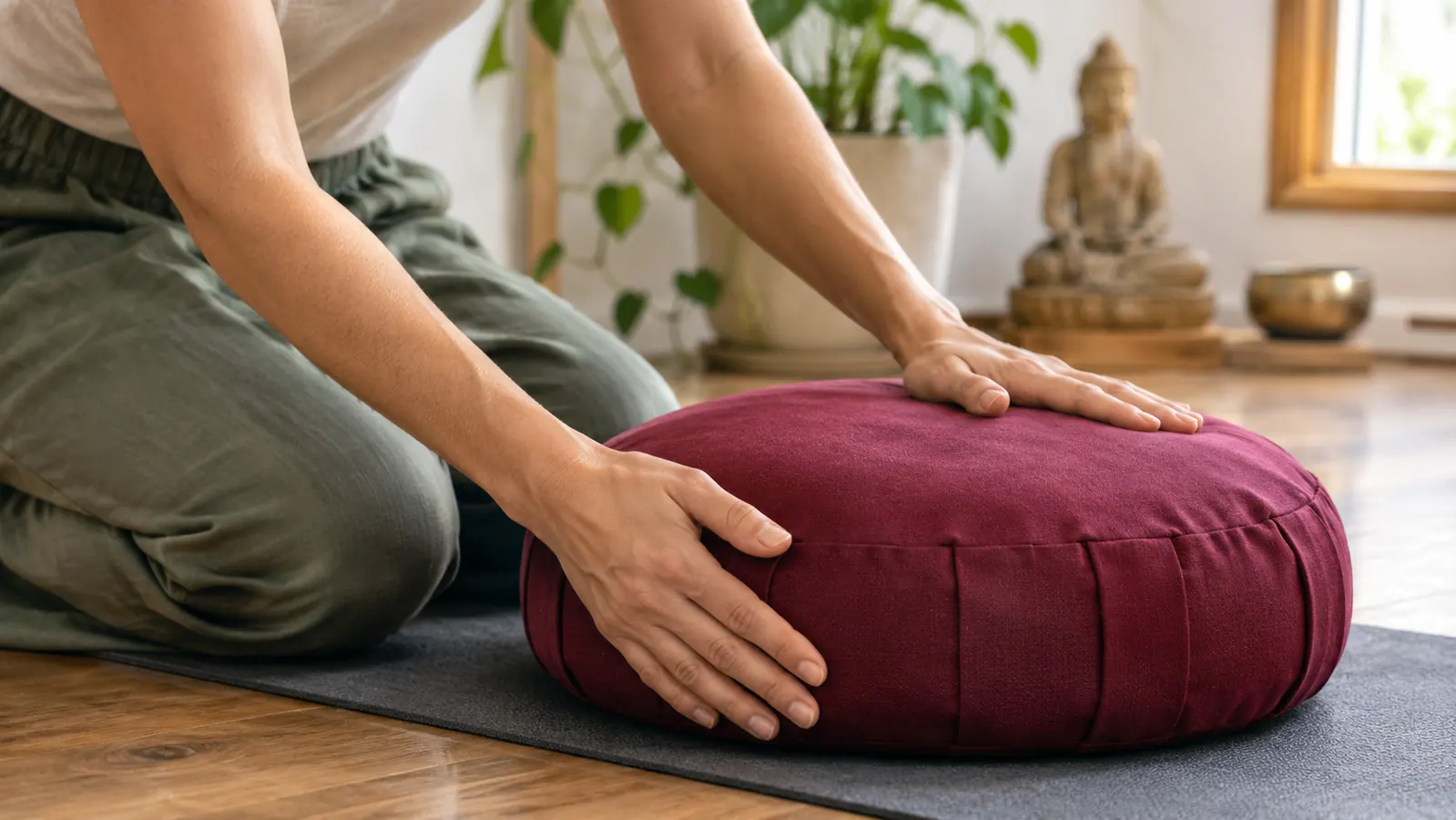
My routine has been steady for years. I pour a cup of tea, carry it to the spare bedroom, strike the singing bowl once to open the sit, and settle onto the cushion for about twenty minutes before breakfast. When I am not sitting, the cushion rests on a low wooden shelf by the window. When I am, I set it on the floor with the taller edge of the crescent behind me. That slight tilt under my hips is the whole reason it works. It tips my pelvis forward just enough that my lower back does not have to work so hard to keep me upright.
The first week was not love at first sit. The cushion is firm, and firm is a shock when you are used to a squishy couch pillow or a folded blanket. My hips complained in a new way for the first few days, because the support was doing something different from what I was used to. I nearly returned it. Then, around day five, the same hips felt better. The firmness stopped being a problem and started being the point. I stopped noticing the cushion and started noticing the sit.
I have also learned to re-shape the cushion before almost every sit. The buckwheat hulls inside shift as you move, and if I sit down without smoothing them into a slight mound, I spend the whole twenty minutes adjusting. This is the thing nobody tells you about a buckwheat cushion. It is not set-and-forget like foam. It asks for thirty seconds of attention before you sit, and occasionally once during a longer sit. Once I accepted that, the cushion and I got along fine.

What Nobody Tells You About the Buckwheat Fill
Buckwheat hulls are not like foam or memory foam. They are firm, they move, and they hold whatever shape you give them. When you sit, the hulls shift around your sitting bones and support the shape of your body in that moment. That is what makes the cushion supportive, and it is also what makes it need attention. I smooth the hulls into a mound with both hands before I sit, and I have learned to do it without thinking. It takes about as long as adjusting a pillow before sleep.
The fill is adjustable, and that is the feature I use more than I expected. The inner compartment unzips so you can add or remove buckwheat hulls to change the firmness and height. During my first month, I took out roughly a cup of hulls because the cushion was firmer than I wanted for my stiff lower back. The process is simple, if slightly messy. I unzip the inner bag, pour a small amount into a bowl, zip the bag closed, and tuck it back inside the cover. I sat on it for a few days, took out a little more, and eventually found the right amount. If you buy this cushion, give yourself permission to do the same.
The hulls are sustainable buckwheat, and the outer cover is 100 percent cotton, so there are no microplastics in the mix. I like that. I breathe this cushion for twenty minutes a day, and I would rather have simple natural materials under me than synthetic ones. I cannot feel the difference in the moment, but I have noticed the cover breathes well in summer, which matters more than I expected.
The firmness is listed as firm, and the description is accurate. This is not a cushion you sink into. It is a cushion you sit on. Your sitting bones rest on the hulls, your hips tilt forward, and your spine stacks. For someone with tight hips and a stiff lower back, that stacking is exactly what I needed. It took me a week to stop wishing for softness and start appreciating the support.
The Cover, the Wash, and the Little Details
The cotton cover is machine washable, and that is a bigger deal than it sounds. My old folded blanket went into the wash rarely, and it showed. I wash the zafu cover a few times a year on a gentle cycle and let it air dry. I take the inner fill bag out first, wash the cover alone, and put everything back together once it is dry. The whole process takes about ten minutes. A cushion you cannot wash is a cushion that slowly collects the dust of your practice. This one does not have that problem.
The cushion is lighter than it looks. It weighs 16 ounces, and the listed dimensions are 17 by 10.5 by 5.5 inches. I move it between my practice corner and the living room when I want to sit by the fire in winter, and I carry it to the library on Tuesday evenings for my circle. It tucks under one arm easily. For a weekly meditation group, that portability matters more than I expected. Nobody wants to wrestle a bulky cushion onto a bus or into a car.
There is a one year limited warranty, which I have not needed because the cushion has held up well. Four years in, the zipper on the inner compartment still moves smoothly, the cotton cover has no tears, and the hulls have not gone flat or dusty. I was not sure a bag of hulls would last this long. I assumed I would be replacing it by now. Instead, it is the rare piece of meditation gear that has needed nothing but the occasional wash.
The solid pattern and simple design mean it does not shout for attention in a room. It looks like a tool, not a decoration. I have had meditation cushions that looked beautiful and sat poorly. This one is the reverse. It is not the prettiest object in my practice corner, but it is the one I reach for most mornings, and after four years that is the quality I care about.
What It Did and Did Not Do for My Practice
Here is what it did. I sit longer without fidgeting. My back does not start complaining at minute twelve the way it used to on the folded blanket. I start my sit calmer because I am not dreading the discomfort, and I finish it more settled. The cushion did not make me a better meditator. It removed a barrier that was making me avoid sitting entirely. That is not nothing. In fifteen years of practice, the biggest improvements have come from removing small obstacles, and this cushion removed a real one.
Here is what it did not do. It did not fix my lower back. When my back flares up, I talk to my doctor, and I switch to my meditation bench for a while. The zafu is a support for a sitting practice, not a treatment for a body that needs care. I would not want anyone to buy this instead of seeing a professional about real pain. If you are dealing with anxiety, grief, or depression, the same applies. A cushion can make a practice more comfortable. It is not a substitute for the people and professionals who help you heal.
I bought a Waterglider meditation bench about a year ago, during a winter when my lower back was worse, and I use both now. On stiff mornings I choose the bench. On ordinary mornings I choose the zafu. They share the same corner of the spare bedroom, and I do not think of them as rivals. The zafu is better when I want my hips tilted forward and my legs folded under me. The bench is better when my knees need a break and my back wants a more upright seat. If you are trying to decide between the two, the honest answer is that it depends on your body on a given day. I am glad I have both.
At my Tuesday evening circle, several people have tried the cushion before committing to their own. One woman in my circle had been sitting on a stack of couch pillows and left with a note about the Retrospec Sedona on her phone. Another found it too firm and chose a round cushion instead. That range of reactions is normal. A cushion is a personal thing, and the honest review of any meditation cushion has to include the fact that one person's support is another person's discomfort.
How It Compares to the Alternatives I Tried
Before the Retrospec Sedona, I tried a folded blanket, a firm couch pillow, and a round meditation cushion borrowed from a friend. The blanket was too thin, the couch pillow too soft, and the round cushion pushed my hips into a position that made my lower back ache. The crescent shape of the Sedona was the first thing that actually matched the way my body wants to sit. That is the honest comparison. It was not the most beautiful option. It was the one that worked.
I have also sat on chairs and benches over the years, and I keep coming back to the floor. For me, sitting on the cushion with my hips elevated and my knees lowered is the position where my mind settles fastest. The bench is a close second, and on stiff mornings it wins. But for the ordinary Tuesday, the zafu is what I choose. If you are comparing options, I would say this: pick the support that lets you forget your body for twenty minutes. For me, that is the Retrospec Sedona.
What I Liked
- Firm, adjustable buckwheat fill supports the hips and lower back
- Cotton cover is machine washable and has held up for four years
- Inner compartment unzips so you can add or remove hulls
- Light at 16 ounces and easy to move around the house
- Simple natural materials, no microplastics
Where It Falls Short
- Needs reshaping before most sits because the hulls shift
- Firm feel takes a week or two to get used to
- Adjusting the fill is a slightly messy process
- Crescent shape does not suit every body or every sitting style
Four years in, the zipper still moves smoothly, the cover has no tears, and the hulls have not gone flat. That is the proof I did not expect from a bag of buckwheat.
Who This Is For
Buy the Retrospec Sedona if you sit on a folded blanket or a couch cushion and your hips, knees, or lower back complain before your sit is over. Buy it if you want a firm, adjustable support that you can tailor to your own body instead of adapting to a one-size-fits-all pillow. Buy it if you value simple natural materials and a cover you can actually wash. Buy it if you are willing to spend thirty seconds reshaping the hulls before you sit. I bought mine for exactly these reasons, and four years later I still sit on it most mornings.
I would also say this to someone newer to meditation: do not buy a fancy cushion before you have a practice. Sit on a folded blanket for a month. If you are still sitting after a month, then invest in a cushion. The Retrospec Sedona is a good investment at that point, because it will serve you for years. But no cushion creates a practice. It only makes the practice you already have more comfortable.
Who Should Skip It
Skip the Retrospec Sedona if you want a soft, plush cushion to sink into. This is firm, and removing hulls will soften it only so far. It will never feel like a pillow. Skip it if you do not want to fuss with the fill, because the hulls shift and the cushion needs reshaping before most sits. Skip it if you have real back or hip pain that you have not talked to a professional about. A cushion can support a practice, but it is not a replacement for medical care. And skip it if you are buying a cushion in the hope that it will make you meditate. It will not.
The same goes for anyone who sits in a chair or on a bench and prefers it. There is no rule that says you must sit on the floor. Some of the most consistent meditators I know use a chair. If a chair or a bench already lets you sit still without pain, you do not need a zafu. Buy one because it helps, not because a meditation cushion is what a meditation practice is supposed to look like.
Start with a cushion that actually supports your sit
If any of this sounds like your own practice, the Retrospec Sedona is worth a look. It is the cushion I have used for four years, and I would buy it again. Check today's price on Amazon.
Amazon Check Today's Price on Amazon →