

For years I timed my sits with the timer on my phone. It worked the way a dripping tap works: it did the job and grated on me every time. The chime was thin, the screen lit up when I reached over to silence it, and more than once I caught myself checking my inbox instead of sitting. When I brought the Silent Mind Tibetan Singing Bowl Set into my practice corner about three years ago, I expected a nicer sound. I did not expect it to change how I open and close every sit, and how I start my Tuesday circle at the library. I have owned the Silent Mind set for three years, and I have used a meditation timer app for longer than that, so this is a comparison between two tools I know well. The question people ask me most often is whether a singing bowl is worth it compared with a simple timer app. This is the honest answer.
Here is the honest short answer. If you need a timer that rings at a precise minute, a meditation timer app on your phone is the better tool. If you want a sound that settles a room and marks the beginning and end of a sit, the Silent Mind bowl does something an app cannot. I use the bowl for my morning sits and for my Tuesday circle, and I keep a timer app on my phone for the days I need an exact end time. The two are not really rivals. But if I had to keep only one, I would keep the bowl. Let me walk you through where each one wins, so you can decide for yourself.
| Silent Mind Tibetan Singing Bowl Set | Meditation Timer App | |
|---|---|---|
| How it marks time | One strike opens the sit, one closes it; the sound fades over a few minutes | Counts down to the exact second and rings when time is up |
| Sound | A clear, resonant tone that fills the room | A small chime from a phone speaker |
| Distraction | No screen, no notifications, nothing to check | The phone is right there, and so is your inbox |
| Cost to start | A one-time purchase of a physical set you can use for years | Free, and likely already on your phone |
| Portability | A bowl, cushion and striker that travel in a cloth bag | Your phone is already in your pocket |
| Battery | Nothing to charge, nothing to die mid-sit | A dead phone means no timer |
| Group practice | One strike starts the circle, one ends it; everyone hears it | People at the back strain to hear a phone chime |
| Extras | User guide, eBook series and a 3D sound bath audio track | Interval bells, gentle end sounds, sleep timers, practice stats |
| Best for | Practitioners who want the sound to be part of the sit | People who want exact timing and extra features |
Where Silent Mind Wins
The first thing I noticed was the tone. The listing says the bowl is designed for first-time users and produces a clear, resonant tone, and that is exactly what happened on my first try. I had never struck a singing bowl before this one, and the easy-play striker worked immediately, in either hand. The sound is not a chime from a speaker. It is a physical presence that fills the room and then fades on its own. The bowl is made of ancient Tibetan metalwork, and it sits on a handwoven Tibetan cotton pillow. In my Tuesday circle, one strike is enough. The room settles. People stop rustling their coats and uncrossing their legs. A phone chime makes people look at their phones. This sound makes people look inward. I remember the first Tuesday I brought it to the library. One woman who had been fiddling with the clasp on her bag all evening went still at the first strike, and we sat the full twenty minutes without a single rustle. That was the moment I stopped thinking of the bowl as a nicer alarm.
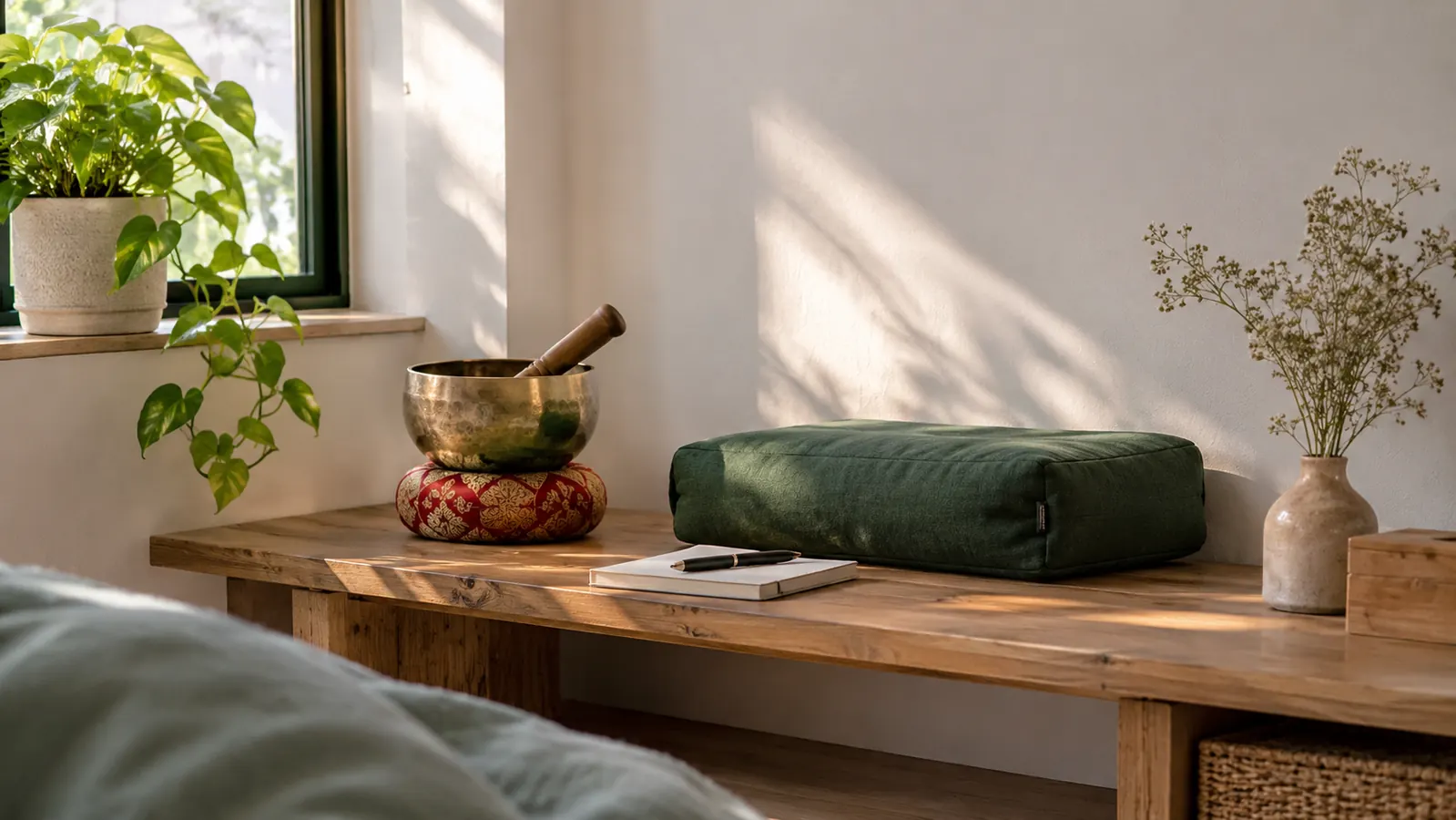
The other thing is what the bowl does not do. It does not light up, buzz, or offer notifications. When I strike it, I am not reaching for a device. I am making the same gesture people have made with bells for centuries, and that continuity is part of why it works for me. The bowl is small, 3.94 inches across, and it came with the cotton pillow and the easy-play striker, so it was ready to use the day it arrived. It lives on the low wooden shelf in my practice corner by the east-facing window. The sight of it is part of the habit. On mornings when I am tempted to skip my sit, I look at the bowl and I sit. A timer app cannot do that. It lives inside the same device that carries my email, and no matter how many times I tell myself I will not check it, the temptation is there. The bowl has no temptation in it.

Where the Timer App Wins
I am not going to pretend the app has no advantages, because it does. When I need to sit for exactly twenty minutes and end at a precise moment, the app counts down to the second. It can ring an interval bell if I want to check my posture halfway through. It can end with a gentle sound instead of a jarring one. Some apps track streaks and minutes, which some people find motivating. My husband uses a timer app for his evening sits because he likes the interval bells and the quiet end sound. For him, the app is the right tool, and I would never argue him out of it. The app is also more forgiving of a busy week. If I miss three days, the bowl does not care, and neither does the app, but the app can show me that I sat on Tuesday and Thursday, which is a small kindness on a hard week. The app can also end without making a sound at all. On mornings when my husband is still asleep, I can set it to vibrate instead of ring, and that is the considerate choice. Last January, when my husband had a bad cold and was sleeping later than usual, I used the vibrate setting every morning for a week. I could sit at 6:15 without waking him, and I was grateful for the option. That is the app's real strength: it bends to the day you are having. On a day when my back is stiff and I can only manage ten minutes, the app meets me there.
The app is also already on your phone. You do not have to remember to pack it, and you do not have to carry a bowl, a cushion and a striker when you travel. A singing bowl set is a beautiful object, but it is still an object. If your practice happens on a train or in a hotel room, the app wins on convenience alone. And if you are not sure meditation is for you yet, the app lets you try it tonight. The bowl is a commitment to a practice. The app is an invitation to one. Both are legitimate ways to begin, and I have recommended both to people in my Tuesday circle, depending on what they are looking for.
If the sound is part of your practice, start here
The Silent Mind Tibetan Singing Bowl Set includes the bowl, a handwoven Tibetan cotton pillow and an easy-play striker, so it works the day it arrives. It is the set I have used to open and close every sit for three years, and it is the sound that starts my Tuesday circle.
Amazon Check Today's Price on Amazon →How I Use It in My Practice
In the morning I sit for about twenty minutes before breakfast. I strike the bowl once to open the sit, and the sound fades while I settle into my breath. Somewhere in those first minutes, the ring becomes a hum, and the hum becomes quiet, and by the time the room is fully quiet, I am sitting still. I strike the bowl again to close the sit, and then I journal. The bowl gives my practice a beginning and an end. Without it, my sits blur into the rest of the day. With it, there is a small ceremony twice a day, and ceremonies are easier to keep than habits. One morning last spring, I struck the bowl to open my sit and a blue jay on the oak outside the window answered with a call of its own. I smiled, and the smile carried into the first minutes of sitting. A countdown timer has never once made me smile. The set came with a detailed user guide and a premium eBook series. I will be honest: I read the guide once and I have not opened the eBooks. The 3D sound bath audio track is a nice extra for evenings, but the bowl itself is the part I use.
On Tuesday evenings, the bowl does different work. My circle meets at the public library, and there are usually eight to twelve of us. People arrive chatty. They have come from work and from errands and from difficult conversations. I strike the bowl once, and the sound moves through the room like a hand smoothing a wrinkled cloth. Then we sit. At the end, I strike it again, and people open their eyes when the sound has faded. A timer app could tell us when to stop, but it could not gather us the way the bowl does. The bowl is the reason the room goes quiet before anyone says a word.
What Three Years Taught Me
Three years in, I can tell you what surprised me. I expected the bowl to be a nice object that I used on good days. Instead, it became the anchor of my practice, the thing I reach for before I sit and the thing I set down when I finish. The vibrations and the tone do what the listing says they do: they help create a grounding atmosphere for meditation, breathwork, or quiet moments. But the real gift is smaller and harder to put in a listing. The bowl asks me to slow down for the ten seconds it takes to strike it, and those ten seconds are often the difference between sitting and skipping. Last autumn I went through a stretch of grief when an old friend died, and for two weeks I did not want to sit at all. The bowl did not fix that. But on the mornings I did sit, I struck the bowl anyway, and the ritual of it carried me through the days I could not find the words to journal. The set is small enough to live on a shelf without taking over the room, and the cotton pillow keeps the bowl steady when I strike it.
I also learned that the tool is never the practice. The bowl is lovely, and I am glad I bought it, but I have sat well with a clock on the wall and I have sat poorly with every tool I own. What the Silent Mind set did for me was remove the friction between deciding to sit and actually sitting. There is no app to open, no screen to lock, no notification to ignore. There is only the bowl, the striker, and the sound. For a person who has spent fifteen years building a daily practice, that is worth more than any feature list.
Who Should Buy Which
Buy the Silent Mind bowl if you want the beginning and end of your sit to feel like a ritual rather than an alarm. Buy it if you lead a group, or if the sight of a bowl on your shelf is what reminds you to sit at all. Buy the timer app if you need exact timing, interval bells, or a practice that lives entirely on your phone. And buy both if you are like me: the bowl for most mornings, the app for the days I need precision. They share my practice corner without arguing. I strike the bowl to open and close each sit, and the app stays quiet on my phone for the mornings when I have to be done by a specific minute.
One more thing, and it is the thing I tell anyone who asks me about my practice. The tool matters less than the sitting. I have sat with nothing but a clock on the wall, with an app, and with this bowl. The bowl makes the sitting feel like a ceremony, and that has kept me coming back for three years. If a timer app does that for you, use the app with my blessing. But if you are drawn to the bowl, if the sound calls to you the way it called to me, you will not regret making it part of your mornings.
A bowl you will actually use
Three years in, the Silent Mind set still sits on my shelf and still starts my circle every Tuesday. It is the rare meditation purchase that earns its place in a daily practice.
Amazon Check Today's Price on Amazon →