
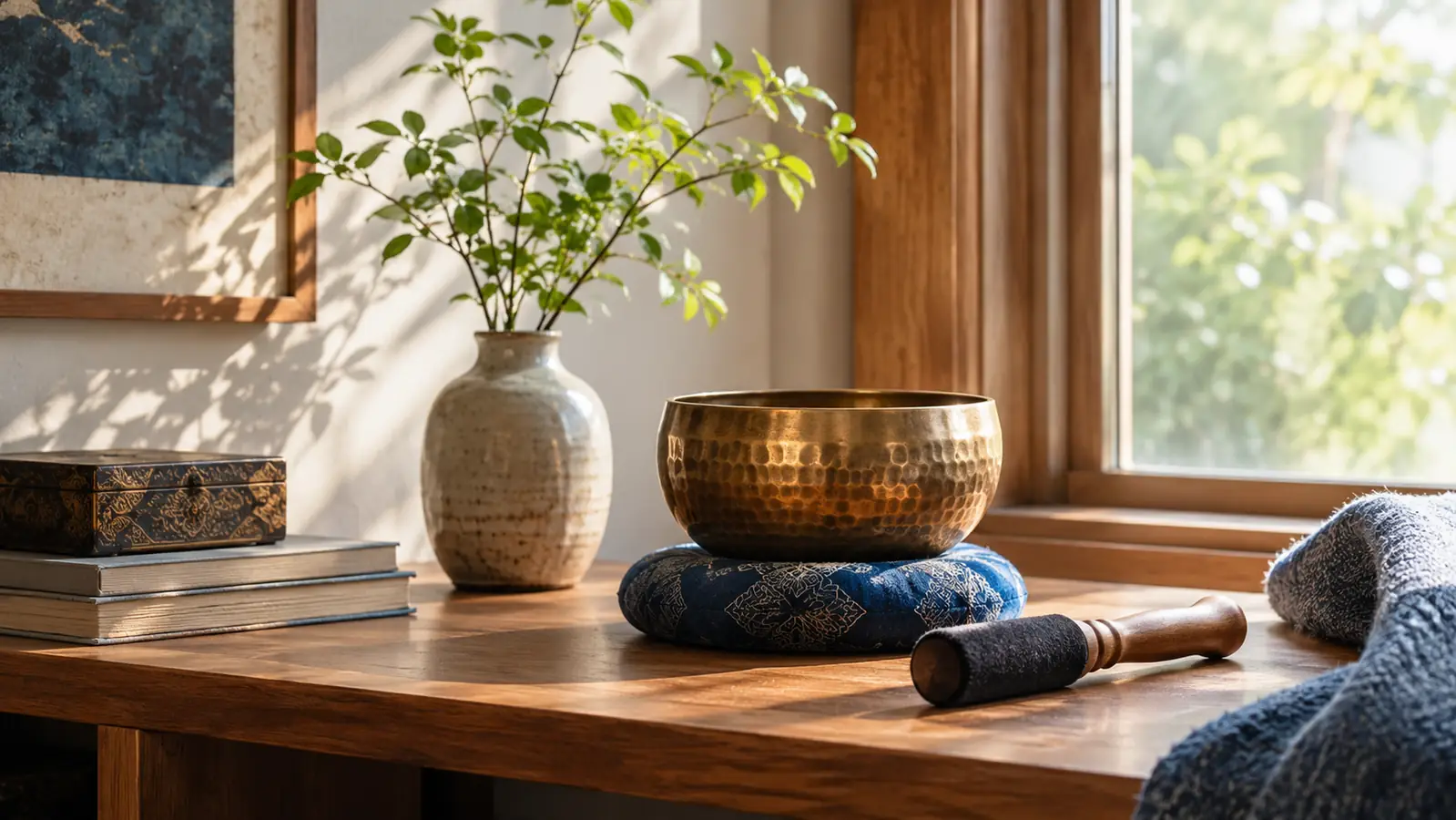
The hardest part of my morning sit was never the sitting. It was the starting. I would settle onto my cushion, tell myself to be present, and then spend the first five minutes second-guessing whether I had actually begun. "Is this the meditation now, or am I still getting ready?" The Silent Mind Tibetan Singing Bowl Set answered that question for me the first morning I used it, and it has opened and closed nearly every sit since.
I am Naomi Whitfield. I have kept a daily sitting and journaling practice for about fifteen years, and I have used this bowl for about three of them. It sits on the low wooden shelf in my practice corner by the east-facing window, and I strike it once to begin and once to end each sit. This is how I do it, what I have learned, and where I would tell a friend to start.
A clear, resonant tone that tells you the sit has begun
The Silent Mind Tibetan Singing Bowl Set comes with the bowl, a handwoven Tibetan cotton pillow, and an easy-play striker, so you can start your own open-and-close ritual the day it arrives.
Amazon Check Today's Price on Amazon →Step 1: Set up your practice corner before you sit
You do not need a dedicated room or a fancy altar. My practice corner is a corner of my spare bedroom with a low wooden shelf and enough floor space for my cushion. The shelf is about hip height, which matters more than I expected. The bowl lives on the shelf with its striker beside it, so I never have to hunt for anything at 6:40 in the morning. That sounds small, but it is the difference between a ritual and a chore. When I first got the bowl, I kept it on a high bookcase in the hallway, and within a week I was skipping the strike on cold mornings because reaching for it felt like too much effort. Moving it down to the practice shelf fixed that completely.
The Silent Mind set includes the singing bowl, a handwoven Tibetan cotton pillow, and a Tibetan easy-play striker. I keep the bowl on the cotton pillow whenever I am not using it, which protects both the bowl and my shelf. The pillow is stuffed firmly enough that the bowl does not wobble, and the striker rests beside it. The included components are exactly what you need to begin: nothing extra to buy, nothing to assemble. I remember unpacking the box on a Tuesday afternoon in early autumn, three years ago, and being struck by how little there was to figure out. Bowl, pillow, striker. That was the whole kit.
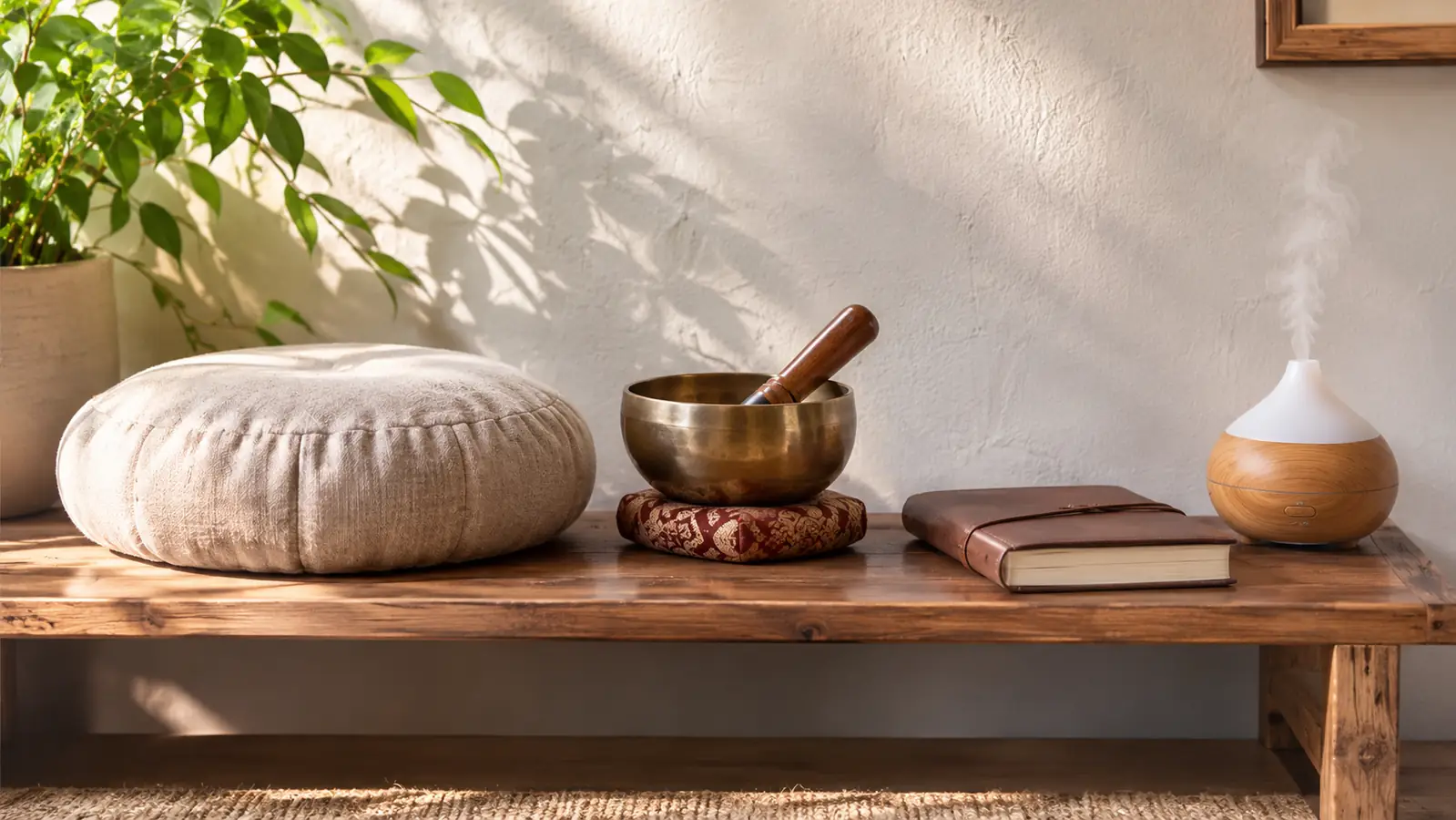
One practical note: the bowl is about 3.94 x 3.94 x 2.5 inches, so it takes up very little space. If you are working with a small corner, a nightstand, or even a sturdy windowsill, it will fit. I like to set mine where I can reach it without leaning, because the less I move before sitting, the sooner I settle. The bowl sits on the left side of my shelf, just below the window, and my journal and diffuser sit on the right. That arrangement has stayed the same for three years, and I think the consistency is part of why the routine holds.

Step 2: Strike the bowl once to open your sit
When I am ready to begin, I take the easy-play striker in my dominant hand and give the bowl a firm, single strike on the rim. The tone is clear and resonant, and it lasts long enough that I can close my eyes while it is still ringing. That is the whole opening ritual. I do not try to make it beautiful or meaningful. I just let the sound mark the line between the day and the practice. On the first morning I used it, I struck too softly and got a thin, clanking sound instead of a ring. I tried again with a little more confidence, and the tone opened up immediately. That was the moment I understood the bowl was forgiving. It does not need a perfect technique, just a clear intention.
The striker is called easy-play for a reason. I had used a rented bowl years ago with a hard mallet and could never find the right angle. The mallet was heavy, the bowl was large, and every strike sounded either dull or harsh. I gave up after a week and went back to using a timer on my phone. This striker felt natural within a few minutes. If you are a first-time user, the bowl and striker are designed to produce a clear tone without much practice, which is exactly what I needed when I started.
Some people like to strike the bowl three times or circle the rim to make it sing. I do that occasionally when I am leading my Tuesday evening meditation circle at the library. The rim circling takes a steady hand, and I practiced it for a few weeks before I could keep the tone going for more than a few seconds. But for a daily home sit, one strike is enough. The sound is a signal to my nervous system, and the signal works better when it is simple. I have also learned that the bowl responds to the room. On damp mornings the tone sounds a little softer, and on clear days it rings a little longer. I enjoy noticing that, though I do not change anything because of it.
Step 3: Let the sound carry you into stillness
After I strike the bowl, I close my eyes and follow the sound until it fades. That usually takes thirty to forty-five seconds, and it gives my mind a clear job to do while my body settles. I am not trying to empty my thoughts. I am just listening, and the listening becomes the meditation. On a particularly scattered morning last winter, I noticed that my mind was already making a grocery list before the tone had finished ringing. I did not scold myself. I just let the sound be the thing I returned to, and by the time it faded I was sitting straighter and breathing more slowly.
The soothing vibrations and resonant tone create a grounding atmosphere for meditation, breathwork, or quiet moments, as the listing puts it. I would phrase it more plainly: the sound gives me something to come back to. When my mind wanders, I can remember the tone and return to my breath. It is a gentle anchor, not a dramatic one. I do not believe the bowl heals anything, and I would never promise that it does. What I can say is that a clear sound at the start of a sit changes the first two minutes, and the first two minutes are when most of my sitting practice used to fall apart.
I sit for about twenty minutes most mornings. With my stiff lower back and tight hips, I sometimes need to adjust my position, and I do. The bowl does not demand that I sit perfectly. It only asks that I begin, and I have found that a clear beginning makes the whole sit more stable. On mornings when I am tired, I have a smaller goal: I tell myself I only need to sit for five minutes, and if the bowl has already been struck, five minutes is easy to reach. More often than not, I stay for the full twenty. The bowl does not know the difference, and neither does my practice. It just gets me onto the cushion.
Step 4: End your sit with a second strike
When my timer tells me the sit is over, I open my eyes, take one full breath, and strike the bowl once more. The closing tone is shorter than the opening one for me, but it serves the same purpose. It marks the end of practice and the return to the day. I sit through the ring, then stand up slowly. One morning I was in a hurry and skipped the closing strike, and I felt the difference all day. Not in a dramatic way. I just noticed that I had moved from meditation straight into my to-do list without a pause, and the day felt more rushed than it needed to.
I have tried ending sits without the bowl, and I always feel a little unfinished. The closing strike gives me a moment of gratitude before I move on to breakfast, and it has become one of my favorite parts of the ritual. It is also a useful signal for the Tuesday circle: one strike to gather everyone, one strike to close. At the library, the room holds about eight to twelve people, and the bowl carries well enough that everyone hears it even from the back row. I have learned to wait a few seconds after the closing strike before saying anything, so the silence has room to land.
If you meditate in the evening, this same open-and-close pattern works beautifully before bed. One woman in my circle uses her bowl to close her day, and she says the second strike is the part she looks forward to. I have not found that the bowl makes me sleep better, and I would never promise that. But a calm ending to the day is its own reward. On evenings when I journal, I sometimes strike the bowl once before I write, then again when I close the journal. It is a small frame around the page, and it helps me write more honestly because I have already let the day settle.
Step 5: Create a rhythm you can keep
The real value of the Silent Mind singing bowl is not the sound itself. It is the rhythm the sound creates. When you strike the same bowl at the same time each morning, your body starts to recognize the cue. I noticed the shift around day four or five, when I reached for the striker before I had even finished settling onto my cushion. My body had learned the sequence before my mind did. After about a week, I found myself settling into stillness faster, not because the bowl was magic, but because I had trained a small habit.
I pair the bowl with a few other cues in my practice corner. A diffuser runs with a few drops of lavender or cedarwood during my sit, and I fill my journal afterward. None of these things is a treatment for anything. They are simply signals that tell my body it is time to slow down. The bowl is the strongest signal because it is the loudest and the most immediate.
The Silent Mind set also includes a premium eBook series, a detailed user guide, and a 3D sound bath audio track. I will be honest: I do not use the audio track often, and I have not finished every eBook. But the user guide was genuinely useful when I first started, and it is a thoughtful addition for anyone who wants to learn more about the tradition behind the bowl.
What Else Helps
A singing bowl is a wonderful anchor, but it works best alongside a few simple supports. I sit on a zafu cushion I have owned for about four years, and on stiff mornings I use a meditation bench instead. I also keep my journal nearby, because writing after my sit helps me carry the stillness into the day. If you are new to meditation, I would suggest starting with the bowl alone, then adding one support at a time. The goal is a practice you can keep, not a perfect setup.
The bowl is not magic. It is a timer and a signal, and after three years of daily use, that is exactly what I want it to be.
Give your sit a clear beginning and end
The Silent Mind Tibetan Singing Bowl Set is designed for first-time users, with everything you need to start today: the bowl, a handwoven Tibetan cotton pillow, and an easy-play striker.
Amazon Check Today's Price on Amazon →