
For years I sat for meditation on a folded wool blanket, then on a zafu, and I told myself the ache in my lower back was just part of the practice. It was not. It was the reason I started skipping days, then weeks, and it was the reason I almost gave up on sitting altogether. If you have a stiff lower back, tight hips, or knees that complain after ten minutes on a cushion, you already know the problem I am describing. The Waterglider Meditation Bench is the tool that helped me sit longer, sit straighter, and actually look forward to my morning sit again.
I am Naomi, a writer in Asheville, North Carolina, and I have kept a daily sitting and journaling practice for about fifteen years. I also lead a small weekly meditation circle at the public library, so I have watched plenty of people wrestle with the same question: how do you sit still when your body is the loudest thing in the room? This guide is the practical, honest version of what I have learned using the Waterglider bench over the past year, especially on the stiff mornings when a cushion makes everything worse.
Sit longer without the ache
The Waterglider Meditation Bench shifts your weight off your legs and gives your lower back a break, so you can settle into practice instead of counting the minutes. It is the bench I reach for on stiff mornings.
Amazon Check Today's Price on Amazon →Step 1: Find your spot and set up the bench
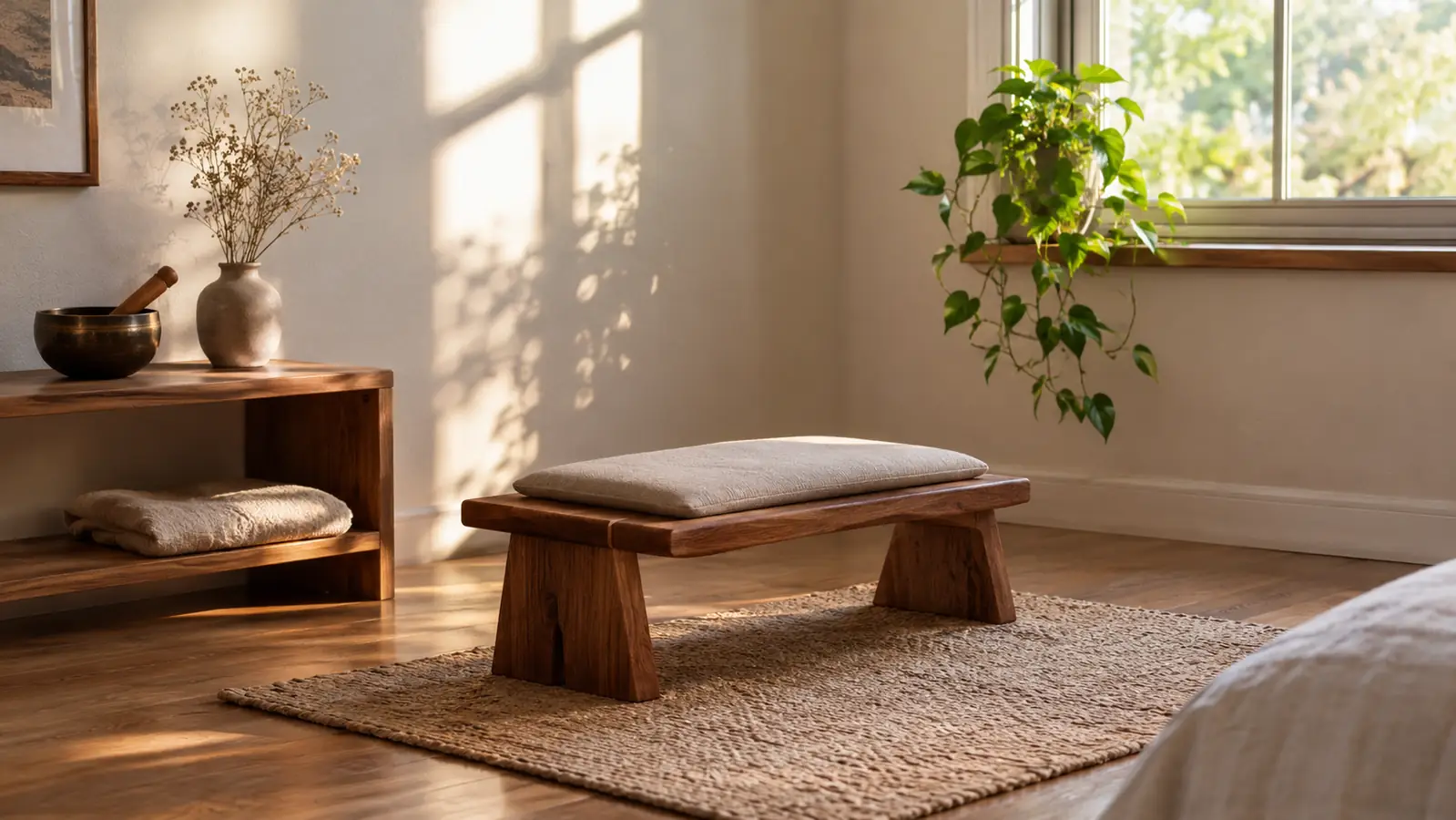
The Waterglider bench needs no assembly, which matters more than you might think. It arrives ready to use, so the only real task is choosing where it lives. I keep mine in the corner of our spare bedroom by the east-facing window, on a small rug next to the low wooden shelf that holds my diffuser and my singing bowl. When the bench has a home, the habit has a home too. You do not have to decide each morning where to sit; you just go to the corner that already looks like a place for stillness.
The bench is 8 inches deep, 18 inches wide, and 8.5 inches high, and it weighs about 3 pounds, so it is easy to move if you want to sit outside or in another room. I have carried it from the spare bedroom to the living room on cold mornings when the sun is better there. It is rectangular, made of acacia wood, and its rounded and angled legs let it rock slightly, like a rocking chair, which helps you find a comfortable angle without having to lift and reposition the whole bench. I bought mine last winter, during a stretch when my lower back was worse than it had been in years. Before that I had tried adding a second cushion to my zafu, then a folded blanket under my hips, and both just moved the discomfort around instead of solving it. The bench was the first thing that actually changed where the pressure landed. It also wipes clean with a dry cloth, which matters when you sit in the same corner every morning.
A note on the surface beneath you: I use a folded mat under my knees because my floor is hardwood. The bench itself is comfortable against the shins, but the floor is the part that gets unforgiving. A yoga mat, a folded blanket, or a thick towel under the knees is enough. Set the bench on a flat, stable surface, kneel behind it, and let the top of the bench meet you where your hips want to rest.
Step 2: Kneel, lean forward, and let the bench take your weight
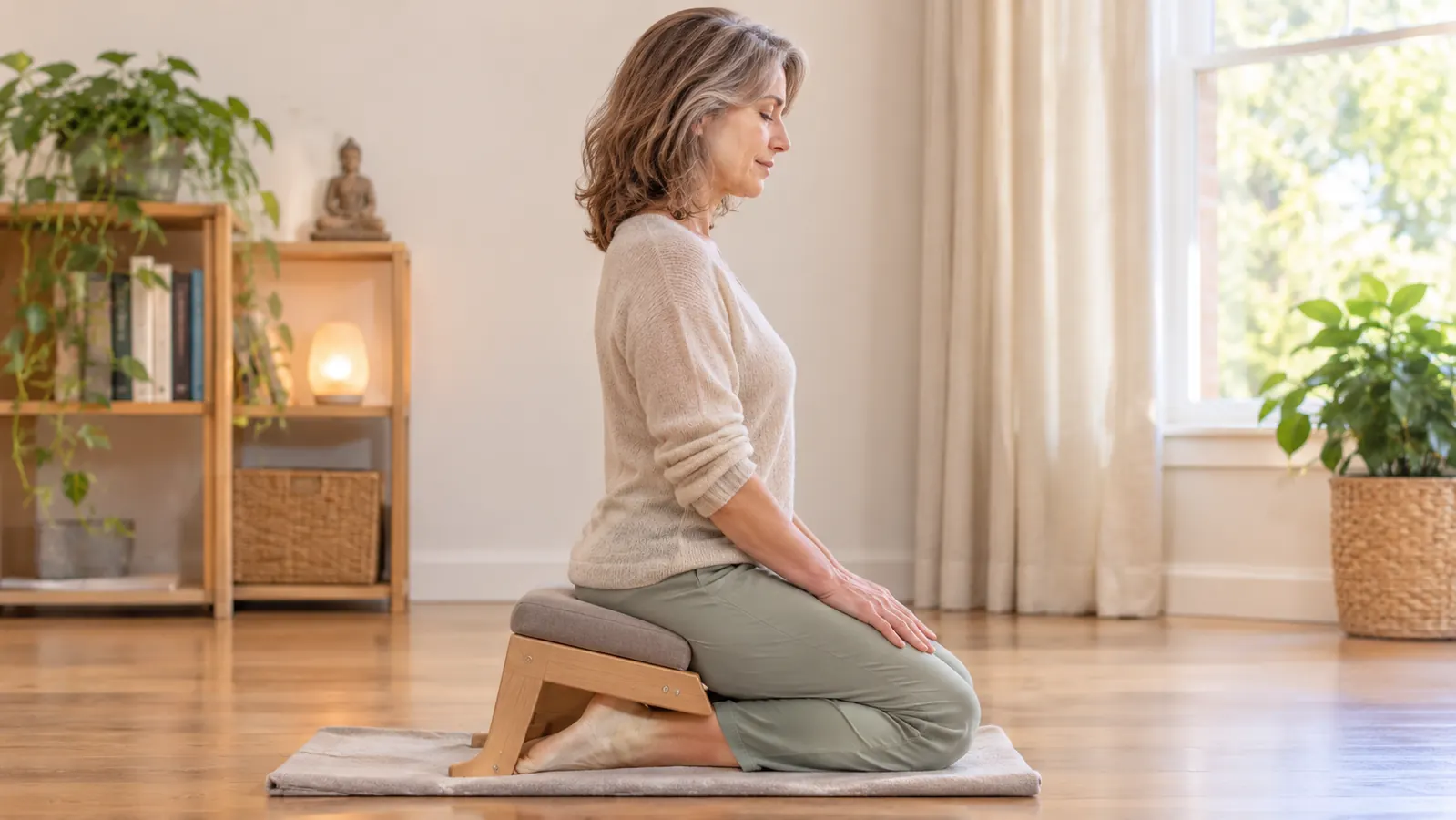
The motion that works for me is simple: kneel behind the bench, place your hands on the top of it, and lean forward gently so your hips settle back onto the seat. The bench is designed for practitioners up to 6 feet tall, and the rounded, angled legs let it rock forward and back just enough to find the angle where your spine feels long instead of collapsed. There is no forcing involved. If it does not feel right, rock a few degrees and try again.
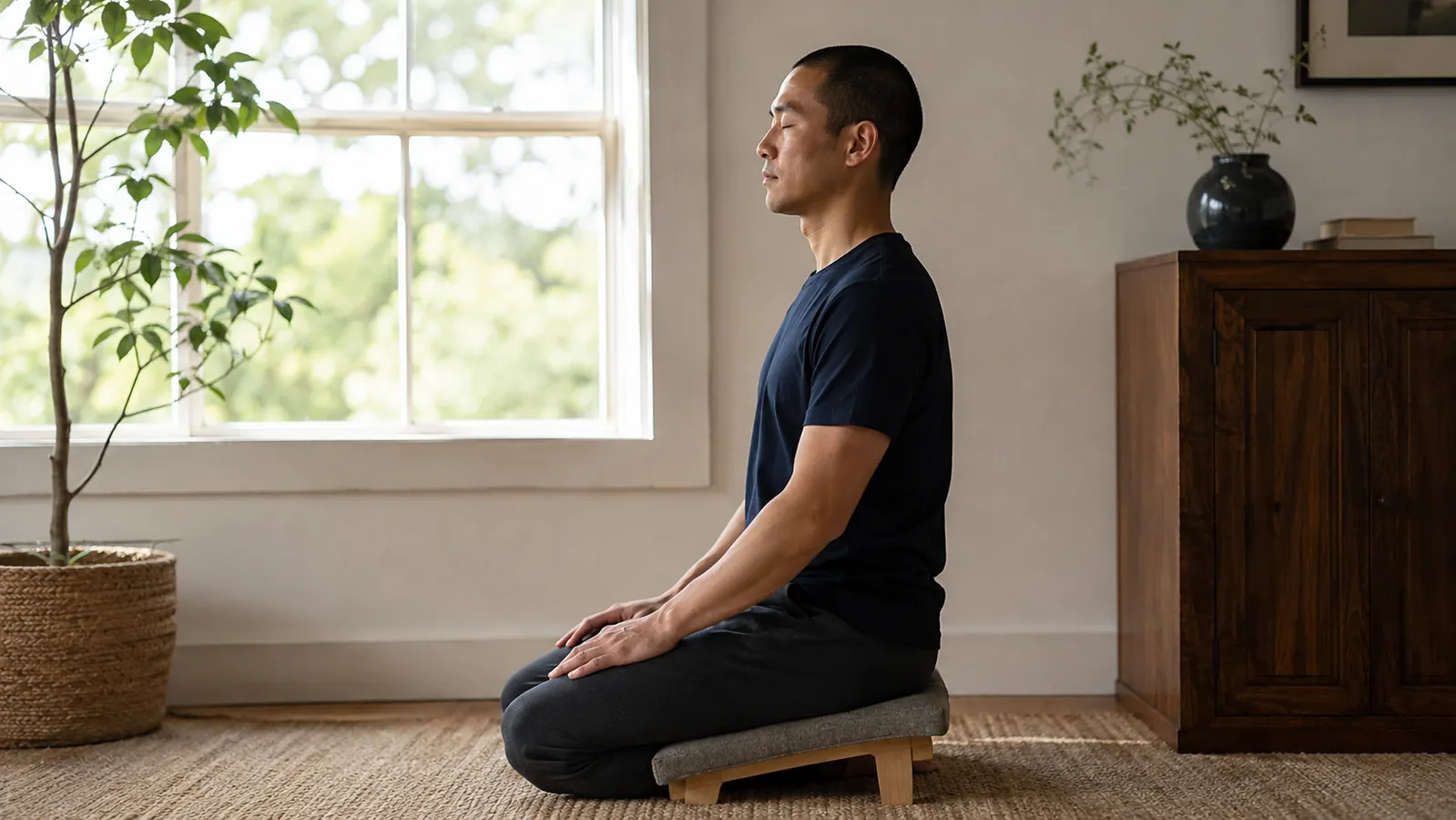
The first time I used the bench, I was surprised by how much of my weight it carried. On a zafu, my hips are elevated but my legs still take a share of the load, and my lower back has to work to keep me upright. On the bench, my shins and knees rest on the mat, the bench supports my hips, and my spine stacks more naturally. The ache that usually appeared around minute eight simply did not show up. That was the moment I understood why people keep a kneeling bench in their practice corner. I remember that first morning clearly. I set a timer for ten minutes, expecting to be shifting by minute five, and instead I sat until the timer rang, with my knees as the only thing asking for attention. A folded mat under them fixed that. I stayed for twelve minutes that day, not to prove anything, but because I had stopped watching the clock. The bench has lived in that corner ever since.
If you have knee trouble, give yourself permission to adjust. I have one woman in my circle who places a small cushion between her calves and the backs of her thighs, and another who uses the bench for only the first ten minutes of a sit before shifting to a chair. The bench is a tool, not a test. You are not doing it wrong if you need a prop or a shorter first session.
Step 3: Settle your hands, your gaze, and your breath
Once you are upright, let your hands rest wherever they land naturally. I place mine on my thighs, palms down, and I let my gaze soften toward the floor a few feet in front of me. Some people in my circle prefer to close their eyes right away. I find that a soft gaze helps me stay awake in the early morning, so I keep my eyes open for the first few minutes and let them close when the sit has settled.
Then I take three slower breaths on purpose. Not dramatic breathing, just three breaths where I feel the ribs move and the shoulders drop. This is the moment the bench earns its place. Because my hips are supported and my spine is not working to hold me up, I can feel the breath moving through my whole torso instead of just the top of my chest. The body stops being a distraction, and the mind has a chance to follow.
I strike my singing bowl once to open the sit, but that is a personal ritual, not a requirement. The bench does not need anything added to it. If you already have a way to begin your practice, keep it. If you do not, a simple count of three breaths is a perfectly good beginning.
Step 4: Sit in shorter rounds at first, then build
The biggest mistake I see new sitters make is trying to sit for twenty or thirty minutes on day one. That is how you end up with a sore back and a bruised ego. Start with five minutes on the bench. Set a timer, sit for five minutes, and get up while it still feels manageable. Do that for a week. Then try seven minutes, then ten. The bench makes longer sits possible, but it does not make them instant. When I first brought the bench home, I sat five minutes a day for a full week, then added two minutes each week after that. By the end of the first month, I was sitting the full twenty minutes on stiff mornings, something I had not managed on the zafu in months. I keep the timer on the low shelf across the room, out of my line of sight, so I am not tempted to watch it count down.
On mornings when my lower back is stiff, I use the Waterglider bench for the whole sit. On other days I sit on my zafu and keep the bench nearby. That rotation has been honest and sustainable for me. The bench is not a replacement for every other seat; it is another option in the corner, and having options is what keeps a daily practice from becoming a daily negotiation with your own body.
If your mind wanders, that is not a failure. I have been sitting for fifteen years and my mind still wanders. The practice is not about having a blank mind; it is about noticing that you wandered and coming back. The bench helps with the physical part of coming back, because you are not constantly shifting your weight or rearranging your legs. When the body is still, the mind has less to complain about.
Step 5: End gently and carry something with you
When the timer ends, I do not jump up. I take one more breath, let my hands rest a moment longer, and then lean forward and rise slowly. I strike the singing bowl once to close the sit, and I stand for a few seconds before walking away. That small pause is the difference between a sit that ends abruptly and a sit that settles into your day.
I also take one thing from the sit into the rest of the morning. It might be a word, a feeling, or simply the memory that I sat down and showed up. Then I move to my journal on the low shelf and write a few lines while the quiet is still with me. Some days I write one honest sentence about how the sit felt. Other days the page fills itself before I am ready to stop. The pen moving while the quiet is still with me is how the practice carries past the bench and into the day. The bench does not do the work for you, but it removes the physical friction that used to stop me before I started.
On mornings when I sit on the bench, the shift into the rest of the day is gentler. I am less likely to rush straight from the cushion into the noise of email and errands. That pause, the few seconds of standing before I leave the corner, has become as important to me as the sit itself, and it is the reason the bench has stayed in the corner for a full year instead of ending up in a closet.
What Else Helps
A bench is one piece of a practice, not the whole practice. In my corner, the Waterglider bench shares space with a zafu for softer mornings, a singing bowl to mark the beginning and end of a sit, and a small diffuser with lavender or cedarwood that I run during my morning sit and evening journaling. The scent is a cue for the habit, not a treatment for anything. I also keep a Five Minute Journal on the shelf, and I fill the morning lines after my sit and the evening lines before bed. None of these tools are necessary. They are simply anchors that make it easier to return to the cushion, or the bench, day after day.
If you are new to meditation, or returning after a long break, I would also say this: be gentle with yourself. A meditation practice built on guilt does not last. The Waterglider bench helped me sit longer because it took away the physical discomfort that made me want to quit. That is a small, practical shift, and it is exactly the kind of shift that keeps a practice alive.
The ache that usually appeared around minute eight simply did not show up. That was the moment I understood why people keep a kneeling bench in their practice corner.
Give your lower back a kinder seat
The Waterglider Meditation Bench is the tool I reach for on stiff mornings, and it has helped me sit longer without counting the minutes. If your body has been the thing standing between you and a daily sit, this is a gentle place to start.
Amazon Check Today's Price on Amazon →